Consistent Hashing in System Design: How to Draw the Ring and Explain Rebalancing
-
Last Updated: August 9, 2026
-
By: javahandson
-
Series

Consistent hashing in System Design explained simply — learn to draw the hash ring, map keys to nodes, and handle rebalancing when servers join or leave.
Picture a busy warehouse with ten workers. Each worker keeps a set of parcels. When a customer asks for a parcel, a manager quickly points to the right worker. Now one worker goes home sick. If the manager reshuffles every parcel across all workers, the whole warehouse stops for an hour. That pain is exactly what consistent hashing was invented to avoid. It is a simple idea that keeps large systems calm when servers come and go.
This article is a hands-on guide to consistent hashing for people learning system design. You do not need to know any special programming language. We use plain pseudocode and simple pictures, so the ideas stick. By the end, you will be able to draw the hash ring on a whiteboard, explain how keys map to servers, and describe rebalancing when a node joins or leaves.
We will start with the problem that plain hashing creates. Then we build the ring step by step. After that, we cover virtual nodes, which fix an uneven-load problem. We finish with real systems, common mistakes, and interview tips. The goal is confidence, not memorized lines.
Say you run a cache spread across several servers. A cache stores hot data in memory so reads stay fast. You have many keys, and each key must live on exactly one server. The classic trick is modulo hashing.
You take a key, hash it into a number, then divide by the number of servers and keep the remainder. That remainder picks the server. With 4 servers, the formula is server = hash(key) % 4. It is fast and easy. So far, so good.
The trouble starts the moment the server count changes. Suppose one server dies, so now you have 3. The divisor changes from 4 to 3. Almost every key now maps to a different server, because the remainder shifts for nearly all of them.
Think about what a mass remap means for a cache. Every key suddenly points to the wrong server. The new server does not hold that data yet, so it must fetch it fresh from the database. For a short window, almost the entire cache is useless.
This event is often called a cache stampede. Thousands of requests miss the cache at once and hit the database together. The database can slow down or even fall over. All of this happens because one server left and the modulo shifted every mapping.
The core flaw is clear. With modulo hashing, changing the number of servers reshuffles most keys, not just a few. We want the opposite. When one server leaves, only its own keys should move. Every other key should stay put. Consistent hashing gives us exactly that.
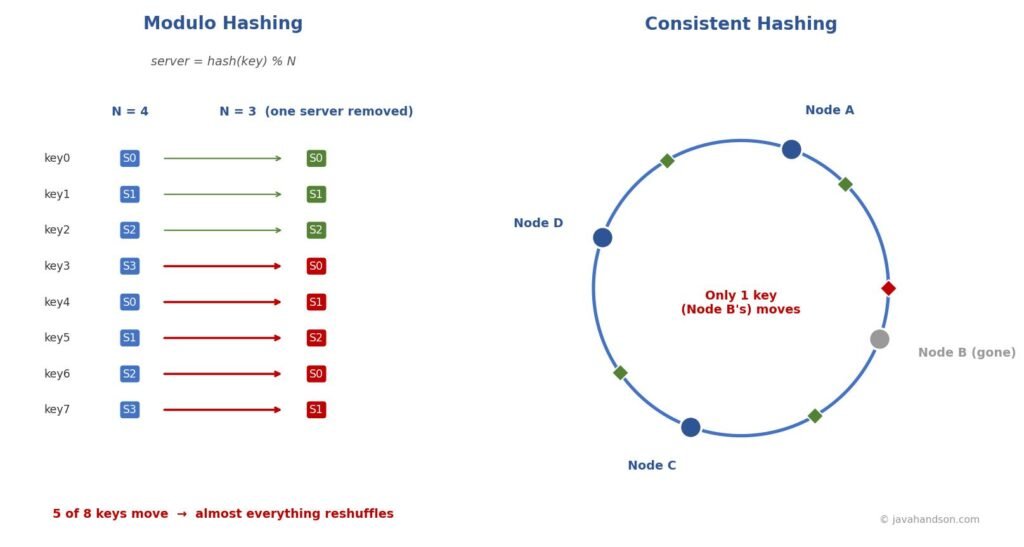
Consistent hashing replaces the straight modulo line with a circle. Imagine a clock face, but instead of 12 hours it holds a huge range of numbers, from 0 up to a very large maximum. The end of the range wraps back to the start, so it forms a closed ring.
Both servers and keys are placed on this same ring. That single shared space is the trick that makes everything else work.
First, we place the servers, also called nodes. We take each node’s name or IP address and hash it into a number on the ring. That number becomes the node’s position. Node A might land near the top, Node B on the right, and so on.
Because the hash spreads values around, the nodes end up scattered across the circle. They do not need to be evenly spaced by design. The hash function drops them wherever the math lands.
Next, we place the keys the same way. We hash each key into a number and mark its spot on the ring. A key is just a point on the circle now, sitting somewhere between two nodes.
So far we only have dots on a circle. The magic is in the rule that connects a key to a node.
Here is the whole assignment rule in one line. To find a key’s owner, start at the key and walk clockwise until you hit the first node. That node owns the key. That is it.
If you walk past the top of the ring without finding a node, you simply wrap around and continue from zero. The ring has no real end, so the search always finds a node. This wrap-around is why we use a circle instead of a line.
The diagram below shows four nodes and four keys on one ring. Each dashed arrow runs clockwise from a key to the node that owns it.
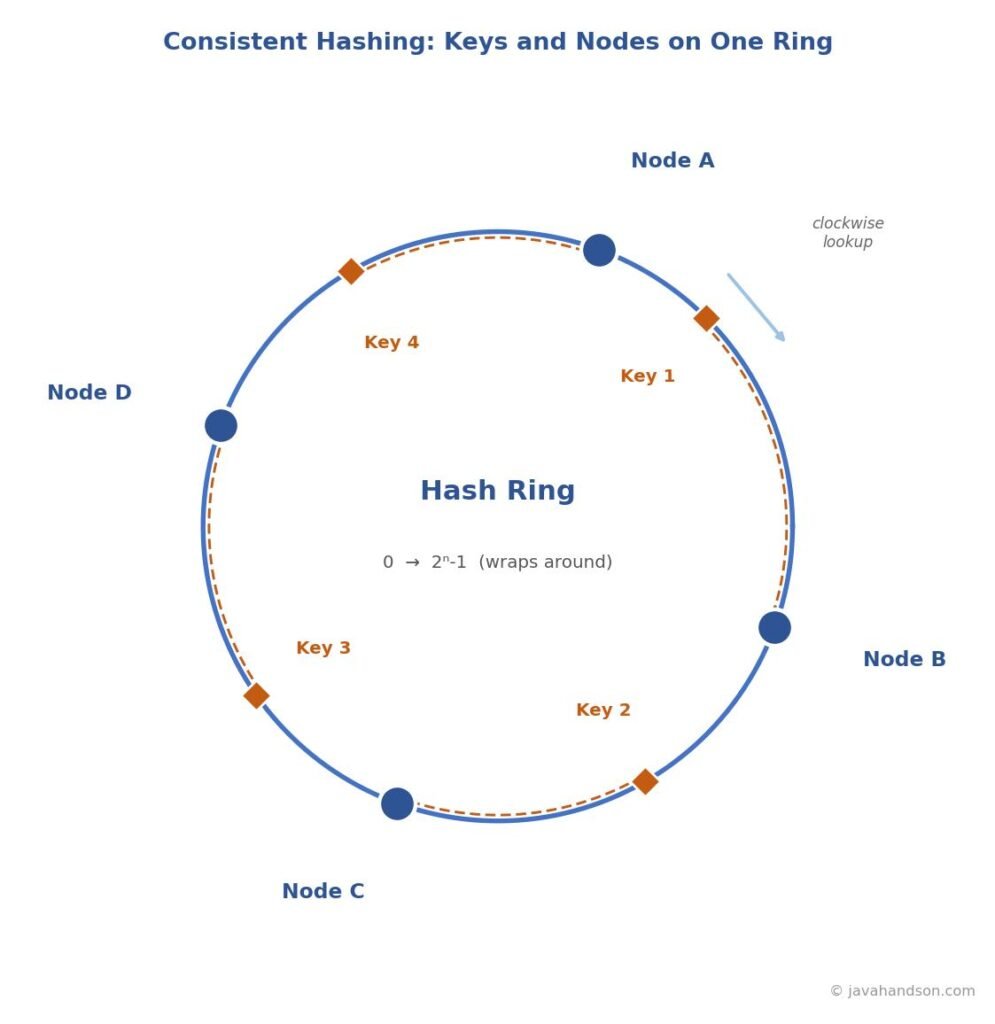
Take a moment to trace it yourself. Key 1 walks clockwise and meets Node B first. Key 4 walks clockwise, wraps past the top, and meets Node A. Once you can trace these arrows by hand, you truly understand the model.
The lookup is short and language-neutral. We keep node positions in sorted order. Then we search for the first node position at or after the key’s hash. If none exists, we wrap to the first node.
# nodes: a list of (position, nodeId), kept sorted by position
# ringMax: the largest value on the ring

function findNode(key, nodes):
    h = hash(key) % ringMax

    # walk clockwise: first node whose position >= h
    for (position, nodeId) in nodes:      # sorted ascending
        if position >= h:
            return nodeId

    # walked past the end, so wrap around to the first node
    return nodes[0].nodeId
In real systems, the loop becomes a binary search on the sorted positions, so lookups stay fast even with many nodes. The idea, though, is exactly this clockwise walk.
Let us walk through a tiny example by hand. Numbers make the idea concrete. We will use a small ring that runs from 0 to 99, so the math stays easy to follow on paper.
First, place three nodes. Suppose their hashes land like this on the ring.
Now place a few keys. Each key hashes to a number, and we apply the clockwise rule to find its owner.
Notice the wrap-around in the last key. It sat after the final node, so it circled back to the first node. That single wrap is what turns a line into a ring.
Keep this small example in mind. It is exactly what you should sketch on a whiteboard when someone asks you to explain the model. Small numbers make the clockwise rule impossible to miss.
Rebalancing is the heart of consistent hashing, and it is what interviewers love to probe. The promise is simple. When the cluster changes, only a small slice of keys moves. Let us see why that holds.
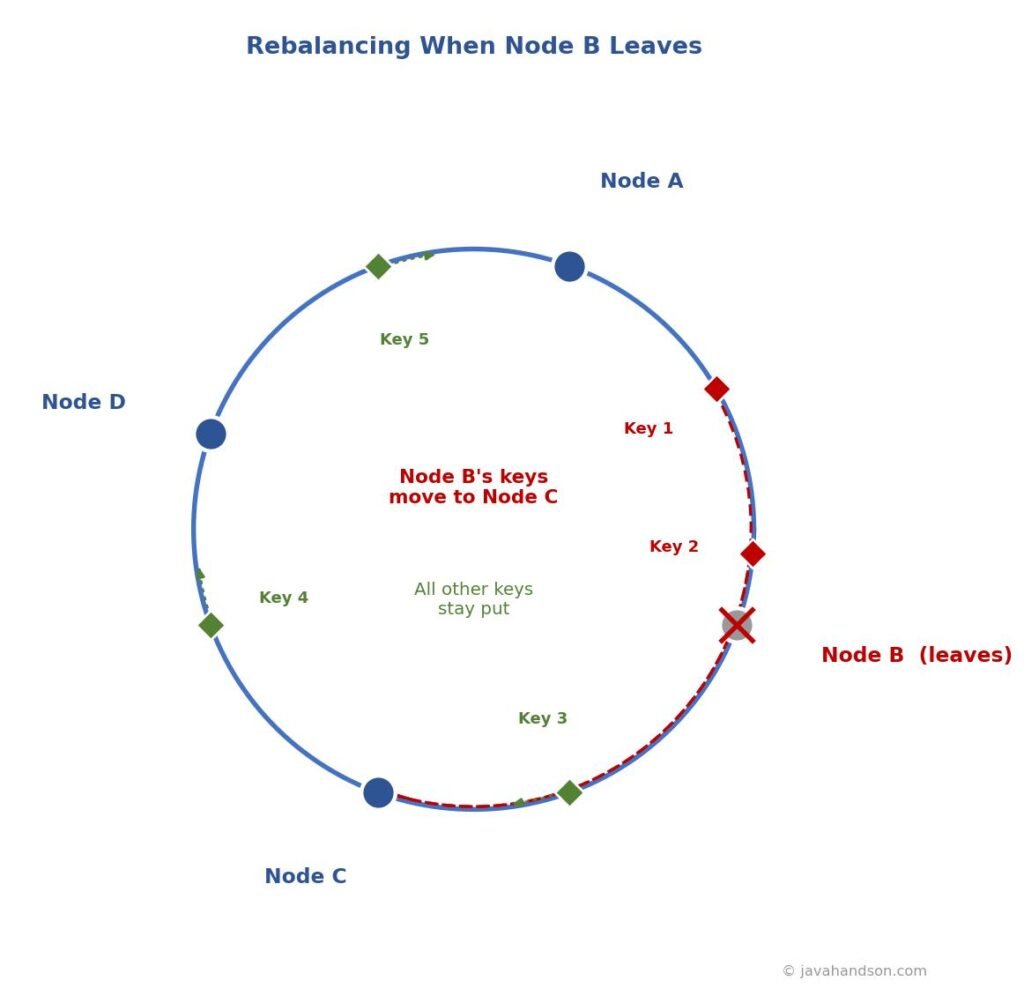
Suppose Node B fails and drops off the ring. Which keys were affected? Only the keys that used to walk clockwise into Node B. Every other key still meets the same node it did before.
Those orphaned keys now keep walking clockwise past B’s old spot. They land on the next node on the ring, which is Node C in our picture. So B’s keys move to C, and nobody else is touched. Only a small fraction of all keys move, not most of them.
This is the exact opposite of modulo hashing. There, losing a server shuffled almost everything. Here, losing a server shifts only that server’s share of keys to its clockwise neighbor.
Adding a node works the same way in reverse. Say we add Node E, and it hashes to a spot between Node A and Node B. The new node inserts itself at that point on the ring.
Now Node E steals only the keys that sit just before it, the ones that used to walk past its position to reach Node B. Those keys now stop at E instead. Node B gives up a slice of its keys to E, and every other node is untouched.
So a join moves keys from exactly one neighbor to the newcomer. On average, adding one node to a cluster of N nodes moves only about 1/N of the keys. That is the guarantee that makes scaling smooth.
Numbers make the promise believable. Go back to our small ring from 0 to 99, with Node A at 10, Node B at 45, and Node C at 80. Suppose keys are spread evenly across all 100 positions.
Each node owns the arc that ends at its position. Node A owns positions 81 to 10, wrapping the top. In the middle, Node B owns 11 to 45. That leaves 46 to 80 for Node C. So each node holds roughly a third of the keys.
Now remove Node B. Its arc, positions 11 to 45, must go somewhere. Those keys walk clockwise and now stop at Node C. So Node C grows, while Node A does not change at all.
Count the movement. Only the keys in B’s arc moved, which is about a third of all keys here. In a real cluster with N nodes, that share is only 1/N. With 100 nodes, a single failure moves just 1 percent of keys. The larger the cluster, the smaller the disruption.
The steps below show what happens when a node joins. Only the affected range of keys is copied, not the whole dataset.
function addNode(newNode, nodes, keys):
    pos = hash(newNode) % ringMax
    insertSorted(nodes, pos, newNode)

    successor = nodeClockwiseAfter(pos)   # the node that had these keys

    # move only the keys that now fall to the new node
    for key in keysOwnedBy(successor):
        if fallsBetween(hash(key), previousNodePos, pos):
            move(key, from=successor, to=newNode)

# every other key stays exactly where it was| Interview Insight A very common interview question is: “How many keys move when a node is added or removed?” The strong answer is about 1/N of the keys, where N is the number of nodes. Explain that only the leaving node’s keys, or the new node’s small slice, ever move. Contrast this with modulo hashing, where nearly all keys move. Saying this out loud, with the clockwise rule, signals real understanding. |
The basic ring has a hidden weakness. With only a few nodes, the hash may place them close together on one side. That leaves large empty gaps elsewhere. A node sitting just after a big gap owns all the keys in that gap, so it gets far more load than its peers.
This imbalance grows worse when a node leaves. All of its keys dump onto a single clockwise neighbor. That one node can suddenly carry double its usual share. We need a way to smooth the load.
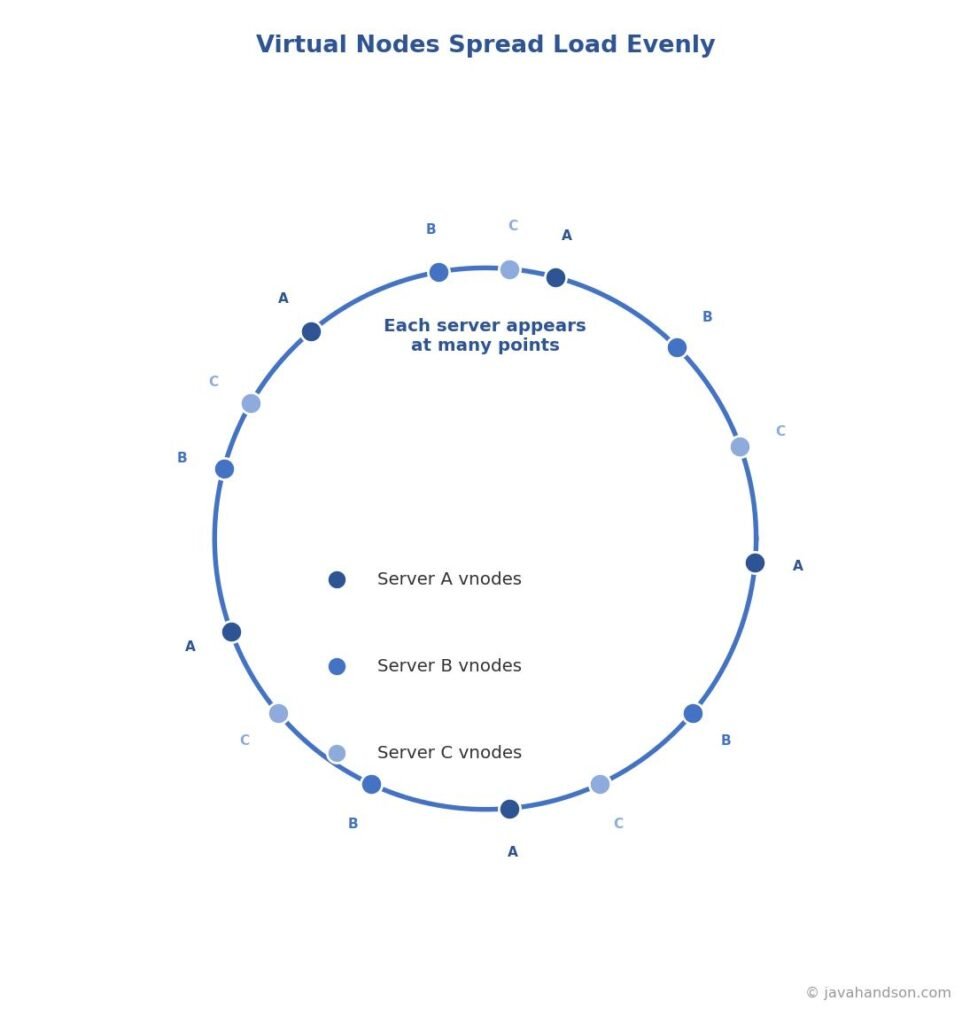
The fix is elegant. Instead of placing each server once, we place it many times under different labels. These extra copies are called virtual nodes, or vnodes. Node A becomes A-1, A-2, A-3, and so on, each hashed to its own spot.
Now a single physical server has many small positions scattered all around the ring. The keys it owns come from many small arcs instead of one large arc. Many small pieces average out much better than one big piece.
With many vnodes per server, the load spreads evenly across the cluster. Random gaps no longer punish one unlucky node, because each server holds pieces everywhere.
Rebalancing also gets smoother. When a real server leaves, its many small arcs each pass to a different clockwise neighbor. The departing load is shared among many nodes, not dumped on one. This is the main reason real systems always use virtual nodes.
There is one trade-off. More virtual nodes mean more positions to store and search. The cost is small, but it is not zero. Systems tune the count, often using a few hundred vnodes per server, to balance evenness against overhead.
Building the ring with virtual nodes is a small change. We simply hash each server several times with a replica index appended to its name.
function buildRing(servers, vnodesPerServer):
    ring = empty sorted map   # position -> physical server

    for server in servers:
        for i in 0 .. vnodesPerServer - 1:
            label = server + "#" + i    # e.g. "ServerA#0"
            pos = hash(label) % ringMax
            ring.put(pos, server)

    return ring

# Lookup is unchanged: walk clockwise to the first position,
# then map that position back to its physical server.Real systems rarely keep just one copy of a key. A single copy is risky, because one node failure would lose that data. Consistent hashing extends neatly to handle copies.
The rule is a small tweak. After finding the first node clockwise, you keep walking and pick the next few distinct nodes too. If you want three copies, you take the first three unique physical nodes clockwise from the key. The first is the primary, and the others are backups.
When those nodes use virtual positions, you must skip vnodes that map to a server you already chose. Otherwise, all three copies could sit on one physical machine, which defeats the purpose. Real systems always pick distinct physical nodes for replicas.
This design is why databases like Cassandra can promise durability. The ring decides the primary owner, and replication walks a few steps further to place safe copies. One clean idea handles both placement and redundancy.
Not every server is the same size. Some machines have more memory or faster disks. It would be wasteful to give a large server the same load as a small one.
Virtual nodes solve this too. To give a server more load, you simply give it more virtual nodes. A big server might get 300 vnodes while a small one gets 100. The big server then owns more arcs and takes proportionally more keys.
This weighting is simple to reason about. Load is roughly proportional to the vnode count. So one small dial, the number of virtual nodes, controls both balance and capacity sharing across mixed hardware.
The whole ring rests on one thing: a good hash function. If the hash spreads values well, nodes and keys scatter evenly. If it does not, the ring skews, and all the balance we worked for falls apart.
A good hash for this job has two traits. First, it spreads inputs uniformly across the whole range, so no region is crowded. Second, it is fast, because you call it on every key lookup. Cryptographic strength is not the goal here; speed and even spread are.
Imagine a hash that maps many similar keys to nearby numbers. Keys that share a prefix would then bunch together on one arc. That arc’s node gets flooded, while other nodes sit idle. The cluster looks balanced on paper but is lopsided in practice.
The same risk applies to node positions. If server names hash to a tight cluster, the ring has one crowded zone and huge empty gaps. The node after a gap drowns in keys. This is exactly the case virtual nodes soften, but a good hash prevents it at the source.
Teams often reach for well-tested, non-cryptographic hashes for speed. Popular picks include MurmurHash, xxHash, and FNV. These spread values well and run fast, which is what a busy lookup path needs.
Some systems still use MD5 or SHA-1 for their even spread, accepting the slower speed. The output is truncated to fit the ring range. The lesson is simple: pick a hash known for uniform output, and test the spread before trusting it in production.
Nodes do not always leave politely. Sometimes a server crashes without warning. Consistent hashing handles this, but the system around it must do its part too. Understanding this makes your design answers realistic.
There is a big difference between a node that blips for ten seconds and one that dies for good. A permanent loss triggers real rebalancing, moving that node’s keys to its neighbor. A brief blip should not, because shuffling data for a node that returns quickly is wasteful.
So systems wait before reacting. They use health checks and a short grace period. If the node comes back, nothing moves. If it stays down past the timeout, only then do its keys migrate. This patience avoids needless churn.
Because keys are replicated to the next few nodes clockwise, a single failure does not lose data. The replicas already hold copies. When the primary drops, a replica steps up and keeps serving reads and writes for those keys.
This is why replication and consistent hashing are close partners. The ring decides placement, and replicas provide the safety net during failure. Neither is enough alone for a serious system.
Some systems add a clever trick called hinted handoff. When a target node is down, another node temporarily accepts its writes and holds a note, or hint, about where they belong. Once the original node returns, the holder forwards the stored writes to it.
This keeps the system available during short outages. Writes are not rejected just because one node is briefly unreachable. The ring stays stable, and no full rebalance happens for a temporary blip. It is a neat way to blend availability with the ring model.
Plain consistent hashing spreads load well on average, but not perfectly. A few popular keys can still make one node hotter than the rest. Modern systems add a refinement to cap this.
The idea is called consistent hashing with bounded loads. Each node gets a maximum load limit, a ceiling it will not cross. When a key’s natural owner is already at its limit, the key simply moves to the next node clockwise that has room.
This keeps the elegant ring behavior while guaranteeing no node gets overwhelmed. It is used in real load balancers to spread requests fairly, even when traffic is bursty. You do not need it for every design, but naming it shows you know the field beyond the basics.
A side-by-side view makes the benefit obvious. The table below compares the two approaches on the points that matter most in a design discussion.
| Aspect | Modulo Hashing | Consistent Hashing |
|---|---|---|
| Key placement | hash(key) % N | Point on a hash ring |
| Keys moved on change | Almost all keys | About 1/N of keys |
| Adding a node | Full reshuffle | Small slice from one neighbor |
| Removing a node | Full reshuffle | Keys pass to next node only |
| Load balance | Even while N is fixed | Even with virtual nodes |
| Best for | Fixed, stable cluster | Elastic, changing cluster |
This is not just theory. Consistent hashing runs inside many systems you may already use. Knowing a few examples makes your interview answers concrete.
The common thread is elasticity. Any system where servers are added or removed often benefits from consistent hashing, because change stays cheap.
A few pitfalls trip up beginners. Being ready for them shows depth in a design conversation.
Consistent hashing is one tool in the sharding toolbox. Sharding means splitting data across many machines so no single one holds everything. The ring is a clean, popular way to decide which shard owns which key.
It pairs naturally with replication and with a good caching layer. The ring picks the owner, replication makes copies for safety, and the cache keeps hot reads fast. Together they let a system grow and shrink without pain.
When you design any large, elastic system, keep this idea close. If servers will join and leave often, plain modulo hashing will hurt you. The ring keeps the system calm through every change, which is exactly what real production demands.
Consistent hashing is a favorite interview topic, because it tests clear thinking, not memorized trivia. Here is how to shine when it comes up. The trick is to explain the picture in plain words and trace it step by step.
Do not jump straight to the ring. First explain why plain modulo hashing fails. Say that changing the server count reshuffles almost every key and can cause a cache stampede. This framing shows you understand the pain the ring solves.
Interviewers value this order a lot. Problem first, then solution. It proves you are solving a real need, not reciting a pattern you saw once.
Whiteboard interviews reward a clear sketch. Draw the circle, drop three or four nodes, and place a couple of keys. Then trace one clockwise arrow from a key to its node. A picture that you narrate beats a wall of words every time.
After the sketch, remove one node live and show which keys move. This single move demonstrates rebalancing better than any definition. It is the moment that convinces the interviewer you truly get it.
Strong candidates predict the next question. After the basic ring, mention the uneven-load problem before being asked, then introduce virtual nodes as the fix. Bringing this up yourself signals depth.
Be ready for the classic numbers question too. State clearly that adding or removing a node moves only about 1/N of keys. If you can also mention replication and hinted handoff, you move from a good answer to a great one.
| Interview Tip When asked to design a system that scales its cache or database horizontally, reach for consistent hashing early. Say: “I would use a hash ring so that adding or removing a node moves only about 1/N of the keys, and I would add virtual nodes to keep the load even.” That one sentence covers placement, rebalancing, and balance in a single breath, which is exactly the clarity interviewers reward. |
A: It stops mass key movement when servers change. With plain modulo hashing, adding or removing a server reshuffles almost every key, which can wipe a cache and overload the database. Consistent hashing moves only a small slice of keys instead.
A: On average, only about 1/N of the keys move, where N is the number of nodes. When a node leaves, its keys pass to the next node clockwise. When a node joins, it takes a small slice from one neighbor. Every other key stays put.
A: Virtual nodes are multiple ring positions for one physical server. Instead of placing a server once, you place it many times under different labels. This spreads load evenly, avoids large empty gaps, and shares a departing server’s load across many neighbors.
A: Hash the key to a point on the ring, then walk clockwise until you hit the first node. That node owns the key. If you pass the top of the ring, you wrap around to zero and keep going, so the search always finds a node.
A: Distributed caches like Memcached clients, distributed databases like Amazon Dynamo, Apache Cassandra, and Riak, some load balancers and proxies, and content delivery networks all use consistent hashing to keep change cheap when servers scale in or out.
Consistent hashing solves one sharp problem with a neat picture. Plain modulo hashing reshuffles almost every key when the server count changes. The ring changes that. Keys and servers share one circle, and each key belongs to the first node clockwise from it.
When a node leaves, only its keys move to the next node. When a node joins, it takes a small slice from one neighbor. Virtual nodes then smooth the load so no single server is overwhelmed. That is the whole model, and you can now draw it and explain it.
Practice the drawing until it feels natural. Sketch the ring, drop a few nodes, place some keys, and trace the clockwise arrows. Then remove a node and show what moves. Once that flows from your hand, you can teach it, and you can ace the interview question with ease.