Consistency Models in System Design: Strong, Eventual, Causal, and Read-Your-Writes
-
Last Updated: August 4, 2026
-
By: javahandson
-
Series

Consistency models in system design explained simply: strong, eventual, causal, and read-your-writes. Learn what each promises, its cost, and when to use it.
Imagine you update your profile picture on an app. You see the new picture right away. But your friend, sitting in another city, still sees the old one for a few seconds. Both of you are looking at the same app, yet you see different things. This small gap is what consistency models are all about.
Consistency models are a core topic in system design. They describe the rules a distributed system follows when many copies of the same data exist. When you store data on more than one machine, those copies can fall out of sync for a short time. A consistency model tells you what a user is allowed to see during that gap.
This article continues our consistency and replication cluster in the system design series. In the replication article, we saw how data gets copied across many nodes. Here, we go one step further. We look at what those copies promise to the reader. We will keep the language simple and neutral, so the ideas apply no matter which database or framework you use.
By the end, you will understand four common models: strong consistency, eventual consistency, causal consistency, and read-your-writes consistency. You will know what each one promises, where each one fits, and why picking the right one shapes your whole design. We will use everyday examples and small pseudocode snippets so the ideas stay clear.
Data lives on many machines in modern systems. We copy data for two big reasons. First, copies keep the system running when one machine fails. Second, copies let users read from a nearby machine, which makes reads fast. This copying is called replication, and it is a good thing.
But replication brings a hard question. When you write to one copy, the other copies do not update at the exact same moment. There is a small delay while the change travels across the network. During that delay, different users may read different values. So the system must decide: do we make everyone wait for all copies to agree, or do we let some users see stale data for a while?
That single decision is the heart of consistency. It is a trade-off, and there is no free lunch. Stronger guarantees make the system easier to reason about, but they cost speed and availability. Weaker guarantees make the system fast and always available, but they push more complexity onto the developer and the user.
This trade-off is not just theory. It shapes real design choices every day. A bank moving money needs tight rules. A social feed showing likes can be relaxed. The right model depends on what your feature can tolerate. Getting this choice wrong leads to angry users or a slow, fragile system.
You cannot talk about consistency without a quick word on the CAP theorem. CAP says a distributed system can offer only two of three things at the same time during a network problem. The three are consistency, availability, and partition tolerance.
A network partition means some machines cannot talk to each other for a while. Partitions happen in the real world, so a distributed system must tolerate them. That leaves a real choice between the other two. When a partition hits, you either stay consistent or stay available. You cannot fully do both.
If you choose consistency, the system may reject or delay some requests until the copies agree. If you choose availability, the system keeps answering, but some answers may be stale. This is why consistency models exist. They are the different points on this line between strict correctness and constant availability.
Keep this idea in mind as we go. Each model we discuss is really a stance on the CAP trade-off. Strong consistency leans hard toward correctness. Eventual consistency leans toward availability. Causal and read-your-writes sit in the useful middle.
Strong consistency is the strictest promise. It says that once a write finishes, every later read returns that new value. No reader ever sees old data after the write is done. The whole system behaves as if there is only one copy of the data, even though many copies exist behind the scenes.
Think of a shared bank balance. You deposit money, and the balance updates. From that moment, anyone who checks the balance, from any machine, sees the new amount. Nobody sees the old balance. That is strong consistency in action, and for money, it is exactly what you want.
To keep this promise, the system must coordinate all copies before it confirms a write. When you write, the system does not reply “done” until enough copies have the new value. Only then does the write count as complete. This coordination often uses a leader node or a voting process across nodes.
Here is the flow in simple pseudocode.
write(key, value):
    send value to all replicas
    wait until a majority confirm they saved it
    then return "success" to the client

read(key):
    ask the leader or a majority of replicas
    return the agreed latest value
Notice the waiting step. The client waits while copies sync up. This waiting is the price of strong consistency. It adds latency to every write, and sometimes to reads as well.
Strong consistency feels safe, and it is. But that safety has a real cost. Because the system waits for copies to agree, each operation takes longer. If some copies are far away or slow, the whole request slows down. Users feel this as lag.
There is a bigger cost too. During a network partition, the system may have to stop serving requests. If it cannot reach enough copies to agree, it refuses to answer rather than risk a wrong value. So strong consistency can hurt availability. You trade uptime for correctness.
Because of this, strong consistency fits features where a wrong value is worse than a slow value. Bank transfers, stock trades, seat booking, and inventory counts all need it. In these cases, showing stale data could cause real harm, so the wait is worth it.
Take seat booking as a clear example. Two users try to book the last seat on a flight at the same moment. Under strong consistency, only one write can win, and the system confirms one booking while it rejects the other. Both users always see a correct, agreed count. Under a weaker model, both might see the seat as free and both might book it. That double booking is exactly the kind of harm strong consistency prevents.
Eventual consistency sits at the other end. It makes a much softer promise. It says that if you stop writing, all copies will agree after some time. But it does not say when. For a short window, different users may read different values, and that is allowed.
The word “eventually” is the key. The copies will catch up, but not instantly. During the catch-up window, the system stays fast and available. It never blocks a read waiting for copies to sync. It just returns whatever the nearest copy holds right now.
Think about a like count on a video. You like the video, and the count goes up on your screen. A friend in another region may still see the old count for a few seconds. Nobody gets hurt by this small gap. Soon both screens show the same number.
Here is the idea in pseudocode.
write(key, value):
    save value to the nearest replica
    return "success" immediately
    // other replicas get updated in the background

read(key):
    return value from the nearest replica
    // this value might be slightly stale
See the difference from strong consistency. The write returns right away. It does not wait for other copies. The sync happens later, in the background. This makes both reads and writes very fast.
Eventual consistency shines when speed and uptime matter more than an exact, instant view. Social media feeds, view counts, product recommendations, and DNS all use it. A few seconds of stale data causes no real problem in these cases.
This model also handles failures well. Because no request waits for global agreement, the system keeps serving even when some copies are down or slow. It stays available during partitions. That is a big reason large-scale systems lean on it so often.
But eventual consistency puts more thought on the developer. You must design features that tolerate stale reads. You also need a way to settle conflicts when two users write different values to different copies at the same time.
Conflicts are the tricky part of this model. Say two users edit the same field on two different copies at once. Both writes succeed locally. Later, when the copies sync, the system finds two different values for one key. It must pick a winner. A simple rule is last-write-wins, where the newer timestamp beats the older one. This is easy but can silently drop a valid change.
More careful systems use version vectors or conflict-free data types. These track the history of each change, so the system can merge edits instead of dropping one. This adds complexity, but it protects user data. The point to remember is simple: weaker consistency shifts conflict handling from the database onto your design. Plan for it early, not after a bug appears.
Causal consistency is a smart middle ground. It does not force all copies to agree instantly. But it does protect the order of related events. If one event causes another, everyone sees them in the right order. Events that are not related can still appear in any order.
The word “causal” means cause and effect. A reply causes a need for the original message to exist first. So causal consistency says: if B depends on A, then anyone who sees B must also see A. This keeps conversations and chains of actions from looking broken.
Picture a comment thread. Riya posts a comment. Arjun reads it and replies. Now his reply depends on her comment. Under causal consistency, no user can see Arjun’s reply without also seeing Riya’s original comment. The cause always shows up before the effect.
Compare this to eventual consistency. Under a purely eventual model, a user might see the reply before the original comment loads. The thread would look strange and out of order. Causal consistency stops that confusing view without needing the full cost of strong consistency.
write(key, value, depends_on):
    record that this write depends on earlier writes
    save value, but respect the dependency order

read(key):
    return a value only after its causes are visible
// effects never appear before their causesCausal consistency gives you sensible order without heavy coordination. It does not make every user wait for global agreement. It only tracks the “happened-before” links between related writes. This keeps the system fast while still avoiding the worst kinds of confusion.
Chat apps, comment sections, and collaborative tools benefit from this model. In these features, order matters within a conversation, but unrelated actions can lag freely. Causal consistency fits that shape well. It protects meaning without paying the full price of strong consistency.
The trade-off is added bookkeeping. The system must track dependencies between writes. This takes extra metadata and logic. For many apps, though, that cost is small next to the benefit of a clean, ordered view.
Read-your-writes consistency solves one very common and very annoying problem. It promises that after you write something, you will always see your own change. Other users might still see the old value for a while. But you, the person who made the change, never see stale data.
This model is user-focused. It cares about your own session. You should never feel like your action did not work. If you post a comment and then refresh, your comment must be there. Seeing your own change vanish feels like a bug, even when the system is fine.
We have all felt this. You update your profile bio. The page reloads, and it shows the old bio. You wonder if the save failed. You try again. This confusing moment happens when a system lacks read-your-writes consistency. Your write went to one copy, but your read hit a different, stale copy.
Read-your-writes consistency fixes this. It makes sure your later reads go to a copy that already has your change. Or it routes your reads through the same place your write landed. Either way, you see your own edits every time.
write(user, key, value):
    save value and remember this user just wrote it

read(user, key):
    if this user has a recent write:
        read from a replica that already has it
    else:
read from the nearest replicaSystems use a few simple tricks to keep this promise. One common way is sticky sessions. The system sends all of one user’s requests to the same server, so that server always has their latest writes. Another way is to track the user’s most recent write and route their reads to a copy that is caught up.
This model gives a big boost to user trust for a small cost. It does not need every copy to agree. It only needs to keep one user’s own view correct. So it stays cheaper than strong consistency while removing a very common source of confusion.
Many real systems combine read-your-writes with eventual consistency. The wider system stays fast and eventually consistent for everyone. But each user still sees their own actions right away. This blend gives a smooth experience without heavy coordination.
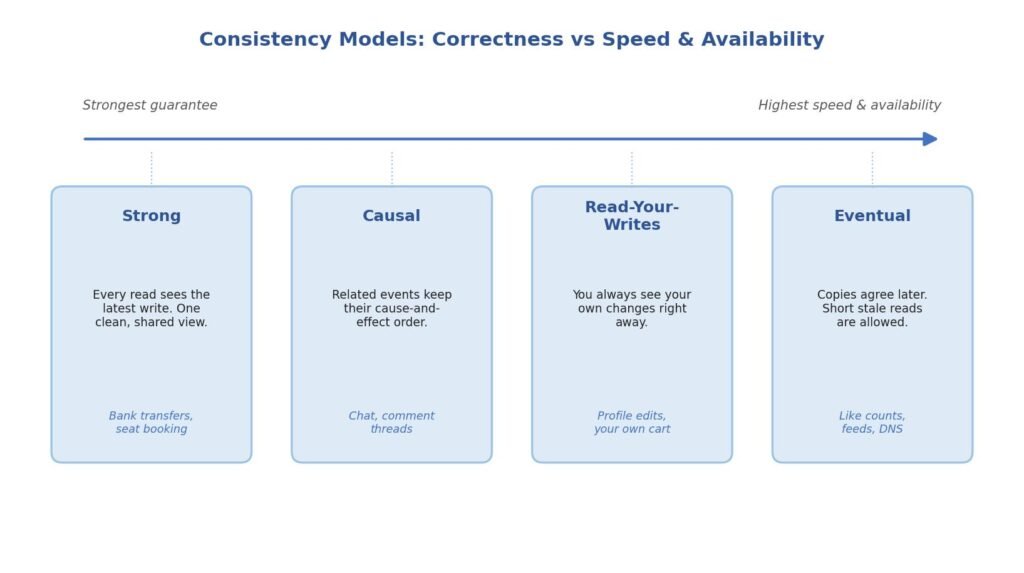
Each model makes a different promise and asks a different price. Strong consistency gives the cleanest view but costs speed and uptime. Eventual consistency gives the best speed and uptime but allows stale reads. Causal and read-your-writes sit in between, each fixing a specific problem cheaply.
The right choice depends on your feature, not on which model sounds best. Money needs strong consistency. A like counter is happy with eventual. Comment threads want causal order so replies never appear before the original message. Profile edits need read-your-writes so you always see your own change. Often a single app uses several models across different features.
The table below sums up the four models at a glance. Keep it handy when you plan a new feature. It maps each model to its promise, its cost, and a typical use case.
| Model | What It Promises | Main Cost | Typical Use |
|---|---|---|---|
| Strong | Every read sees the latest write | Slower writes; less available on partition | Payments, seat booking, inventory |
| Eventual | Copies agree after a short delay | Stale reads; conflict handling on you | Feeds, like counts, DNS |
| Causal | Related events keep cause-effect order | Extra dependency tracking | Chat, comment threads, collaboration |
| Read-Your-Writes | You always see your own change | Routing or sticky sessions per user | Profile edits, your own cart |
The trade-off is always the same shape. As you move from strong to eventual, you gain speed and uptime but give up an instant, single view of the data. Causal and read-your-writes let you buy back just the part of that view you actually need, without paying the full price. That is why real systems rarely stick to one model everywhere.
Start by asking what a stale read would cost. When a wrong value causes real harm, lean toward strong consistency. A short and harmless delay means eventual consistency keeps you fast. If order between related events matters, reach for causal. And when a user must always see their own change, add read-your-writes on top.
You do not have to pick just one for the whole system. Real designs mix models per feature. A shopping app may use strong consistency for payment and stock, eventual consistency for reviews, and read-your-writes for a user’s own cart edits. Matching the model to the need is the real skill.
People new to this topic tend to trip on the same points. Being aware of them early saves a lot of pain later.
System design interviews often test this exact trade-off. When you design a feature, state the consistency model out loud and justify it. Say why a payment needs strong consistency and why a feed is fine with eventual. This shows you think about correctness and scale together.
Expect follow-up questions on the CAP trade-off. A strong answer explains that during a partition, you must choose consistency or availability. Name which one your feature picks and why. Tie it back to the business need, not just the theory.
Also be ready to mix models. The best answers rarely pick one model for the whole system. They match each feature to the weakest model that still keeps users happy. That balance of correctness, speed, and cost is exactly what interviewers want to hear.
| Interview Insight A common question is: “Can you have both strong consistency and high availability?” The honest answer is no, not during a network partition. The CAP theorem forces a choice. State which one your feature picks, explain why, and tie it to the business need. That reasoning matters more than naming any single database. |
A: A consistency model is the set of rules a distributed system follows to decide what value a reader sees when the same data is stored on many machines. Because copies take time to sync after a write, the model defines what stale or fresh data a user is allowed to see during that gap.
A: Strong consistency guarantees that every read after a write returns the newest value, so no one ever sees stale data, but it costs speed and can reduce availability. Eventual consistency lets copies catch up over a short window, so reads may be briefly stale, in exchange for higher speed and uptime.
A: Causal consistency preserves the order of related events. If one event causes another, such as a reply to a comment, every user who sees the effect must also see the cause first. Unrelated events can still appear in any order, which keeps the system fast without confusing users.
A: Read-your-writes consistency promises that after you make a change, you always see your own change on later reads, even if other users still see the old value for a while. Systems provide it using sticky sessions or by routing your reads to a copy that already has your write.
A: During a network partition, the CAP theorem forces a choice between consistency and availability. Each consistency model is a stance on that trade-off: strong consistency favors correctness, eventual consistency favors availability, and causal and read-your-writes sit in the useful middle.
A: Ask what a stale read would cost. Use strong consistency where a wrong value causes real harm, such as payments or seat booking. Use eventual consistency where a short delay is harmless, like feeds or like counts. Add causal for ordered conversations and read-your-writes so users always see their own edits. Most real apps mix several models across features.
Consistency models are the rules that decide what users see when data lives on many machines. Strong consistency gives one clean, correct view but costs speed and uptime. Eventual consistency keeps the system fast and always on but allows short stale gaps. Causal consistency protects the order of related events at a modest cost. Read-your-writes makes sure you always see your own changes.
None of these is the single best choice. Each one is a tool for a different job. The real skill is matching the model to the feature, and often mixing several within one system. Ask what a stale read would cost, and let that answer guide you.
Carry this habit into your next design. Name your consistency needs early, choose the weakest model that still keeps users happy, and you will build systems that stay both fast and correct. Master this trade-off, and the harder topics in distributed systems will feel far more natural.