Structured Concurrency in Java 27 (JEP 533): A Beginner’s Guide to the Seventh Preview
-
Last Updated: October 17, 2026
-
By: javahandson
-
Series

Structured Concurrency in Java 27 (JEP 533) made simple. Learn StructuredTaskScope, the new ExecutionException change, joiners, and how to try the preview.
Modern Java apps do many things at once. A single web request might call three services together. For years, we managed these parallel calls by hand. Honestly, that approach was fragile and easy to get wrong.
Structured Concurrency in Java 27 fixes this old pain. It arrives as JEP 533, the seventh preview of the feature. In this guide, we will understand it step by step, in plain language.
I have spent many years building banking integrations. Over there, one payment request often fans out to several backend calls. So this topic sits close to my daily work. Let me share what I have learned.
By the end of this guide, you will know:
Let us begin.
Let me start with the pain point. Virtual threads made threads cheap. You can now start a million of them without fear. However, cheap threads brought a fresh problem.
The problem is simple. When one task fails, its sibling tasks keep running. Nobody tells them to stop. As a result, they waste CPU, memory and open connections.
Imagine a product page. It needs three things at once: user details, inventory and price. A beginner often writes this with ExecutorService and Future.
// Do NOT ship this pattern in production
ExecutorService exec = Executors.newVirtualThreadPerTaskExecutor();

Future<User>      userFuture  = exec.submit(() -> userService.fetch(userId));
Future<Inventory> invFuture   = exec.submit(() -> inventory.check(sku));
Future<Price>     priceFuture = exec.submit(() -> pricing.quote(sku, userId));

User      user  = userFuture.get();   // throws if the user fetch fails
Inventory inv   = invFuture.get();    // inventory + pricing threads
Price     price = priceFuture.get();  // keep running. Nobody stopped them.
Now think about a failure. Suppose the user call throws an error. The inventory and price threads still run in the background. Your calling code has already moved on. Meanwhile, those threads keep holding resources.
This is called a thread leak. Worse, the compiler cannot catch it. There is no warning and no exception. The extra work simply continues past its useful life.
In a busy service, these leaks pile up fast. During an outage, you may collect hundreds of stuck threads. Your connection pool drains quietly. After that, the whole service slows down.
| 💡 Interview Insight Interviewers often ask why virtual threads alone are not enough. The honest answer is correctness. Virtual threads make threads cheap, yet they do not stop leaks. Structured concurrency adds the missing safety on top. |
So what is the fix? Structured concurrency treats a group of related tasks as one unit of work. In Java, you get this through java.util.concurrent.StructuredTaskScope.
The idea rests on one simple rule. No thread started inside a scope can outlive that scope. The JVM enforces this for you. It is not just a guideline or a polite best practice.
Let me put it plainly. When the scope closes, every child thread has already finished. If one task fails, the scope cancels the rest. Then it waits for them to stop before moving on.
Structured concurrency targets three weak spots of hand-made threading:
That last point helps a lot in production. You can run a JSON thread dump with jcmd and see which request owns which threads. With old-style threading, this was nearly impossible.
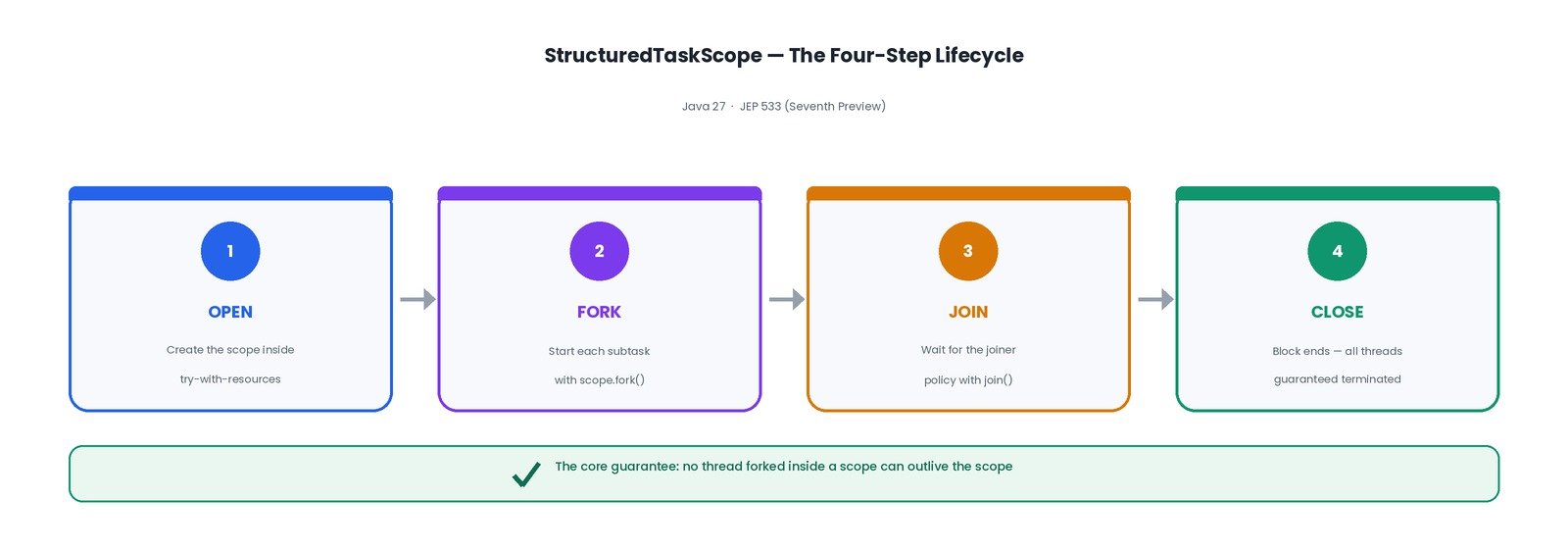
Every use of StructuredTaskScope follows the same rhythm. There are just four steps. Once you learn them, the rest feels natural.
// Enable with: --enable-preview on javac and java
try (var scope = StructuredTaskScope.open(joiner, config)) {

    Subtask<User>      userTask  = scope.fork(() -> userService.fetch(userId));
    Subtask<Inventory> invTask   = scope.fork(() -> inventory.check(sku));
    Subtask<Price>     priceTask = scope.fork(() -> pricing.quote(sku, userId));

    scope.join();  // blocks until the joiner policy is satisfied

    // Subtask.get() is safe here: all threads have completed
    return new ProductResponse(userTask.get(), invTask.get(), priceTask.get());

} // scope.close() — all threads guaranteed terminated
Let me walk through each step:
One rule matters most here. You call subtask.get() only after join(). Before that, the result may not be ready. So join() is your safe synchronisation point.
The close() step is the real safety net. Even if your code throws early, close() still runs. It cancels any task still running and waits for it to stop. Therefore, no thread can escape the block.
| 💡 Interview Insight A classic question is: “what if I return early from the try block?” The answer is that close() still cancels and waits. This is stronger than ExecutorService.shutdownNow(), which is only best-effort and may leave tasks running. |
A Joiner decides when the scope should stop waiting. Most apps need only two built-in policies. Let us look at both.
This is the most common pattern. You fork several tasks and need every result. If any one fails, the whole thing fails fast.
record ProductPage(User user, Inventory inv, Price price) {}

ProductPage buildProductPage(String userId, String sku)
        throws InterruptedException, ExecutionException {

    try (var scope = StructuredTaskScope.open(
            Joiner.allSuccessfulOrThrow(),
            cfg -> cfg.withTimeout(Duration.ofSeconds(3)))) {

        Subtask<User>      userTask = scope.fork(() -> userService.fetch(userId));
        Subtask<Inventory> invTask  = scope.fork(() -> inventory.check(sku));
        Subtask<Price>     priceTask= scope.fork(() -> pricing.quote(sku, userId));

        scope.join(); // throws ExecutionException if any subtask fails

        return new ProductPage(userTask.get(), invTask.get(), priceTask.get());
    }
    // All three threads are guaranteed terminated here.
}
Here is the flow on failure. One task throws an error. Then the scope cancels the others at once. Next, join() reports the failure to you. Finally, close() waits for every thread to exit.
By the time you catch the error, there are zero leftover threads. That is the key promise. You get clean failure without any manual cleanup.
The second pattern is the mirror image. You fork several tasks that do the same job. Then you take whichever one finishes first.
String fetchWithFallback(String key)
        throws InterruptedException, ExecutionException {

    try (var scope = StructuredTaskScope.open(
            Joiner.anySuccessfulOrThrow())) {   // first success wins

        scope.fork(() -> primaryCache.get(key));    // fast path
        scope.fork(() -> secondaryCache.get(key));  // warm standby
        scope.fork(() -> database.fetch(key));      // source of truth

        return scope.join(); // first result; throws if ALL fail
    }
    // One success cancels the remaining two subtasks.
}
This fits hedged requests very well. For example, you may hit a cache, a replica and a database together. The moment one returns, the scope cancels the rest. So you never waste a database round trip on a cache hit.
If every task fails, join() throws an error instead. The cause carries one of the failures. This gives you a clean way to handle total failure.
Here is a quick map of the common joiners:
| Joiner factory | Cancels when… | join() returns | Typical use |
|---|---|---|---|
| allSuccessfulOrThrow() | any subtask fails | List<T> of results | Fan-out needing all results (default) |
| anySuccessfulOrThrow() | any subtask succeeds | T, the first result | Hedged requests, fallback chains |
| awaitAllSuccessfulOrThrow() | any subtask fails | void (Runnable tasks) | Fire-and-forget with an error gate |
| Custom Joiner | your own logic | your result type | Quorum, partial success, custom rules |
Most teams start with the first two rows. The custom joiner is there when you need special rules. For now, the two defaults cover nearly everything.
Now let us get to the headline. JEP 533 is not a redesign. It is a focused polish of three small things. Still, these changes matter for real code.
This is the biggest change for everyday code. In earlier previews, a failed task threw FailedException. That type was preview-only and unfamiliar to most developers.
From JDK 27, the standard joiners throw ExecutionException instead. This is the same wrapper you know from Future.get(). The real cause still sits in getCause().
try (var scope = StructuredTaskScope.open()) {
    Subtask<String> user    = scope.fork(() -> findUser(userId));
    Subtask<List<Order>> os = scope.fork(() -> fetchOrders(userId));
    scope.join();
    return new Response(user.get(), os.get());
} catch (ExecutionException e) {
    switch (e.getCause()) {
        case IOException ioe     -> handleIo(ioe);
        case TimeoutException te -> handleTimeout(te);
        default                  -> throw e;
    }
}
So the familiar catch-then-switch pattern works again. If you caught FailedException before, update those catch blocks. That is the only migration step here.
The second change is about types. StructuredTaskScope and Joiner now carry a third type parameter. The docs call it R_X. It stands for the exception that join() can throw.
So Joiner<T, R> becomes Joiner<T, R, R_X>. Do not panic, though. For normal app code, the compiler infers all of it. Your source looks exactly the same.
This mainly helps library authors. If you write a custom joiner, the throws clause becomes part of the type. As a result, callers get a precise checked-exception contract on join().
The third change removes some boilerplate. Earlier, adding a timeout or a name to the default policy felt clumsy. You had to pass a Joiner next to the configuration.
JEP 533 adds a new open() overload for this. It uses the default policy and takes a configuration operator. The operator is a UnaryOperator<Configuration> over the scope’s settings.
try (var scope = StructuredTaskScope.open(
        cfg -> cfg.withTimeout(Duration.ofSeconds(2)).withName("checkout"))) {
    scope.fork(() -> fetchCart(userId));
    scope.fork(() -> fetchProfile(userId));
    scope.join();
}
Now you set a timeout or name in one clean call. No extra Joiner is needed for the common case. In short, the simple path got simpler.
| 💡 Interview Insight An interviewer may ask: “what actually changed in the seventh preview?” Name the three items: ExecutionException instead of FailedException, the new R_X type parameter, and the open() overload for configuration. Then add that the core design is stable. |
A little history helps you read older tutorials. Structured concurrency has travelled a long road. It started as an incubator feature years ago.
Here is the short timeline:
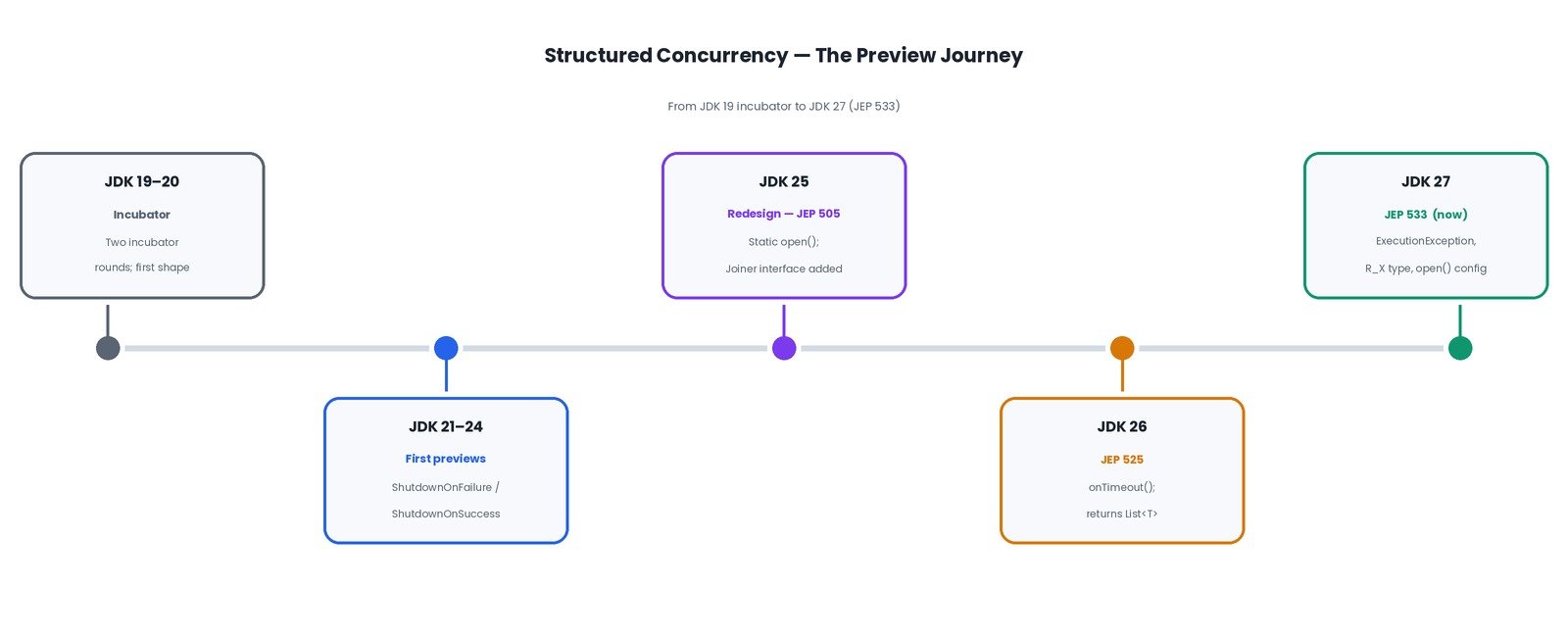
Notice the pattern. Each round gets smaller than the one before. That narrowing is a healthy sign. The API is clearly settling down.
However, it remains a preview for now. The JEP does not commit to a final date yet. Many in the community expect it to finalise soon. Until then, treat it as a preview.
Having the basics is nice. But patterns make it real. Let me show a few that match daily work.
Service calls need deadlines. Otherwise, one slow backend blocks everything. Luckily, the new open() overload makes this easy.
You saw the timeout version in section 5.1 already. The whole scope gives up after three seconds. If the deadline fires, join() stops waiting. Then close() cancels the slow tasks. So one lazy service cannot hold your threads hostage.
Scopes nest very naturally. A subtask can open its own inner scope. Then it forks its own children inside that inner scope.
The safety guarantee is transitive. Inner threads finish before the inner scope closes. That, in turn, happens before the outer scope closes. So you can build deep task trees with full leak protection.
Real apps carry context, like a trace ID. Structured concurrency works well with ScopedValue (JEP 506). Child tasks inherit the bound value automatically.
static final ScopedValue<String> TRACE_ID = ScopedValue.newInstance();

Response handleRequest(String requestId, String sku) throws Exception {
    return ScopedValue.where(TRACE_ID, requestId).call(() -> {
        try (var scope = StructuredTaskScope.open(Joiner.allSuccessfulOrThrow())) {
            var userTask  = scope.fork(() -> userService.fetch(TRACE_ID.get()));
            var priceTask = scope.fork(() -> pricing.quote(sku));
            scope.join();
            return new Response(userTask.get(), priceTask.get());
        }
    });
}
No thread-local copying is needed here. Every subtask in the tree reads the same trace ID. This keeps your logs and traces tidy across threads.
| 💡 Interview Insight A good follow-up is: “how do you propagate request context to subtasks?” Mention ScopedValue, which finalised in JDK 25. Say that bindings flow into every forked subtask automatically, even inside nested scopes. |
Structured concurrency is still a preview in JDK 27. So you must opt in at both compile and run time. You do this with the --enable-preview flag.
For Maven projects, configure two plugins:
<plugin>
  <groupId>org.apache.maven.plugins</groupId>
  <artifactId>maven-compiler-plugin</artifactId>
  <configuration>
    <release>27</release>
    <compilerArgs>
      <arg>--enable-preview</arg>
    </compilerArgs>
  </configuration>
</plugin>

<plugin>
  <groupId>org.apache.maven.plugins</groupId>
  <artifactId>maven-surefire-plugin</artifactId>
  <configuration>
    <argLine>--enable-preview</argLine>
  </configuration>
</plugin>For a quick test from the terminal, use these commands:
javac --release 27 --enable-preview ProductService.java
java  --enable-preview ProductService
One caution before you ship. Preview APIs can still change between releases. So avoid preview-dependent code in long-lived production services. Also keep a clear upgrade plan if you do experiment.
Let me share a few lessons to save you debugging time.
| 💡 Interview Insight A strong closing point is this. Structured concurrency is narrow by design. It does not replace CompletableFuture pipelines or reactive streams. Use it for parent-child fan-out that needs cancellation and no leaks. |
A: It is a preview feature (JEP 533, the seventh preview) that treats a group of related tasks as one unit of work. You use it through StructuredTaskScope. Its core rule is simple: no thread forked inside a scope can outlive that scope, so failures cancel siblings and no thread leaks.
A: Three things. The standard joiners now throw ExecutionException instead of the preview-only FailedException. StructuredTaskScope and Joiner gained a third type parameter (R_X) for the exception that join() can throw. And a new open() overload lets you set a timeout or name without passing a custom Joiner.
A: Mostly only your catch blocks. If you caught FailedException in an earlier preview, switch to ExecutionException. The original cause is still available through getCause(), so the catch-then-switch pattern keeps working.
A: ExecutorService leaks threads silently. If one task fails, its siblings keep running in the background. StructuredTaskScope guarantees the opposite: when the scope closes, every child thread has already terminated. The JVM enforces this, unlike shutdownNow() which is only best-effort.
A: It is still a preview, so you opt in at both compile and run time with the –enable-preview flag. In Maven, add it to the compiler and surefire plugins with release set to 27. From the terminal, use javac –release 27 –enable-preview and java –enable-preview.
Structured concurrency in Java 27 is easier than it first looks. The core rule is a single line: no thread outlives its scope. Everything else flows from that one promise.
Here is the quick recap:
Start small with one fan-out method. Add a timeout and context next. Soon, leak-free concurrency will feel completely normal.