Static Methods in Interface: A Practical Guide for Java Developers
-
Last Updated: October 22, 2026
-
By: javahandson
-
Series

Learn static methods in interface in Java — syntax, calling rules, real JDK factories like List.of(), and private methods added in Java 9, explained simply.
Java 8 changed interfaces in two big ways. Most people talk about default methods. But the same release also added static methods in interface, and this feature is just as useful. It lets you keep helper and factory methods right inside the interface they belong to.
Before Java 8, an interface could only declare abstract methods. So where did you keep the little helper methods that went with an interface? You dumped them in a separate utility class. That worked, yet it always felt a bit scattered.
A static method inside an interface fixes that. It gives the interface a tidy home for its own helpers. In this guide, we will take it slowly and from the ground up.
Here is what we will cover:
Let us start with the basics.
Before we go into interfaces, let us refresh the word static. It is a small word that trips up many beginners. So a quick recap helps.
A static member belongs to the type itself, not to any single object. You do not need an instance to use it. Think of Math.max() or Integer.parseInt(). You never create a Math object. You just call the method on the class name.
int biggest = Math.max(10, 20);     // called on the class, no object
int number  = Integer.parseInt("42"); // same idea
So static means type-level, not object-level. Keep that one line in your head. A static method in an interface follows the very same idea. It belongs to the interface, and you call it on the interface name.
A quick contrast makes this solid. An instance method needs an object to run. A static method does not. Here is the difference in two lines:
String text = "hello";
int len = text.length();          // instance method — needs the object 'text'
int code = Integer.parseInt("5"); // static method — no object needed
So length() runs on a specific String object. On the other hand, parseInt() runs on the Integer type itself. A static method in an interface sits firmly in the second group. You never need an object to call it.
Every feature solves a real pain. So let me show you the pain first. Once you feel it, the feature makes perfect sense.
Before Java 8, interface authors followed a common pattern. They wrote an interface for the contract. Then they wrote a second class full of static helpers for it. Look at these famous pairs from the JDK:
So you had two types for one idea. The interface held the methods you must implement. The helper class held the handy static methods. For example, you sorted a list with Collections.sort(), not with something on List itself.
This split was not terrible. However, it had clear downsides. You had to know two names instead of one. New developers often could not guess the helper class name. Also, the two types could drift apart over time.
Java 8 offered a neater option. Now the interface can hold its own static helpers. So the factory and utility methods live right next to the contract. There is no need for a separate companion class anymore.
That is why modern interfaces skip the helper class. Instead of a Lists utility class, the List interface itself gives you List.of(). The method sits where you would naturally look for it. As a result, the API feels simpler and easier to discover.
| 💡 Interview Insight An interviewer may ask why static methods were added to interfaces in Java 8. The strong answer: to let an interface hold its own helper and factory methods, instead of pushing them into a separate utility class like Collections. This keeps related methods together and makes the API easier to find. |
A short code view makes the shift clear. In the old style, you called a helper on a separate class. In the new style, you call it on the interface itself:
// Old style (pre Java 8): helper lives in a separate class
List<String> list = new ArrayList<>();
Collections.addAll(list, "a", "b", "c");

// New style (Java 9+): factory lives on the interface
List<String> list2 = List.of("a", "b", "c");
Both lines build a list. Yet the second one is shorter and easier to find. You look at List, and the factory is right there. So the static method keeps the helper close to the type it serves.
The syntax is simple. You add the static keyword, a return type, and a method body. It looks almost like a normal method, just inside an interface.
Let us build a small Shape interface. It has one abstract method, area(). It also offers a static factory method that creates a circle:
public interface Shape {
    double area();                 // abstract method

    // static factory method
    static Shape circle(double radius) {
        return () -> Math.PI * radius * radius;
    }
}
Notice two things here. First, area() has no body, so it stays abstract. Second, circle() has the static keyword and a full body. The lambda is a quick way to return a Shape whose area() is already defined.
You call the static method on the interface name. Not on an object. The call reads very naturally:
Shape c = Shape.circle(5);
System.out.println(c.area());   // 78.53...
So Shape.circle(5) builds a Shape for you. After that, you call area() on the result as usual. This is the factory pattern in action, and the interface hosts the factory itself.
You might ask a fair question here. Why use a static factory method at all? A constructor also creates objects. However, a static factory gives you a few nice powers that a constructor cannot.
An interface cannot even have a constructor. So a static factory method is the natural way to say “give me an instance of this type”. That is exactly why the JDK uses them so often.
Let me show a case closer to real work. Suppose you have a Notifier interface. Different classes send email, SMS, or push alerts. You want one clean way to pick the right one by name.
public interface Notifier {
    void send(String message);

    // static factory chooses the right implementation
    static Notifier of(String channel) {
        return switch (channel) {
            case "email" -> new EmailNotifier();
            case "sms"   -> new SmsNotifier();
            default      -> new PushNotifier();
        };
    }
}
Now the caller writes Notifier.of(“email”) and gets the right object. The caller never names EmailNotifier directly. So you can add a new channel later with zero changes on the caller side. This is a clean, common use of a static method in an interface.
The calling code stays short and readable:
Notifier notifier = Notifier.of("sms");
notifier.send("Your OTP is 123456");
Notice how the caller only ever touches the Notifier type. The concrete classes stay hidden behind the factory. So your code depends on the interface, not on the details. That is good design, and the static method makes it easy.
Static methods in interfaces follow a few firm rules. These rules are strict, and they often show up in interviews. So let us go through each one with care.
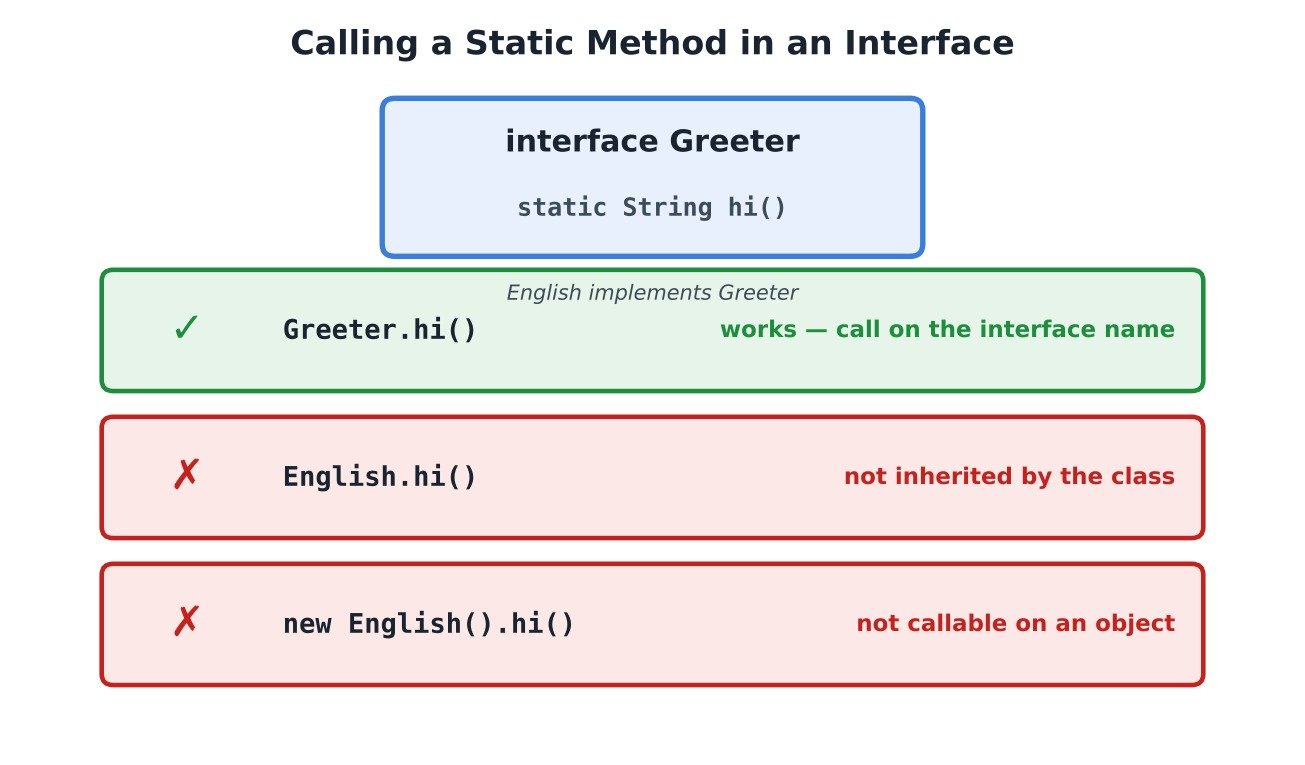
This is the most important rule. A static method in an interface is not inherited by the classes that implement it. So the implementing class does not get that method as its own.
interface Greeter {
    static String hello() { return "Hi!"; }
}

class English implements Greeter { }

// Greeter.hello();   // works
// English.hello();   // does NOT compile — not inherited
Read that last line carefully. English implements Greeter, yet English.hello() fails to compile. The static method stays with the interface only. This behaviour is different from static methods in a normal class, and we will see why soon.
Since the method is not inherited, you also cannot call it on an instance. A Greeter object has no hello() method on it. Only the interface name works:
Greeter g = new English();
// g.hello();          // does NOT compile
String msg = Greeter.hello();   // correct
So always reach for the interface name. This rule keeps things clear. Anyone reading the code can see exactly which type owns the method.
A class cannot override a static interface method. There is nothing to override, because the method is not inherited in the first place. A class may write its own static method with the same name, but that is a brand new, unrelated method.
This is a key contrast with default methods. A default method is inherited and can be overridden. A static method is neither. Because of this, static methods never cause the diamond problem. Two interfaces can both have a static hello(), and a class that implements both still compiles fine.
| 💡 Interview Insight A sharp interview question: can you override a static method from an interface? No. It is not inherited, so there is nothing to override. This also means static interface methods never take part in the diamond problem, unlike default methods. |
Here is a point that confuses people. A functional interface must have exactly one abstract method. So can it also have static methods? Yes, it can. Static methods do not count against that rule.
The rule only limits abstract methods. Static and default methods are free to join. That is why Comparator stays a functional interface even with its many static helpers. It still has just one abstract method, compare().
@FunctionalInterface
interface Parser {
    int parse(String text);          // the single abstract method

    // a static helper is allowed
    static Parser trimming() {
        return s -> Integer.parseInt(s.trim());
    }
}

Parser p = Parser.trimming();
System.out.println(p.parse("  42  "));   // 42
So the lambda still fills the one abstract method. Meanwhile, the static method gives you a ready-made parser. This mix is very common in clean, modern Java code.
You can see the same mix in the JDK. Predicate is a functional interface with one abstract test() method. Yet it also carries static helpers like Predicate.isEqual(). The lambda and the static factory live together without any conflict.
Here is a subtle point that many developers miss. Static methods behave differently in an interface than in a class. The difference is about inheritance.
When a class has a static method, a subclass does inherit access to it. You can call it through the subclass name. The subclass can also hide it with its own static method of the same name:
class Parent {
    static String info() { return "Parent info"; }
}
class Baby extends Parent { }

System.out.println(Baby.info());   // "Parent info" — inherited access
So Baby.info() works, even though Baby never declared info(). The static method flows down through class inheritance. This is called method hiding when the subclass redefines it.
Interface static methods break this rule on purpose. They do not flow down to implementing classes. The Java designers chose this to avoid confusion. An interface can be implemented by many unrelated classes, so inheriting static methods there could get messy fast.
In short, remember this contrast:
| 💡 Interview Insight Expect this comparison: is a static method inherited the same way in a class and an interface? No. A subclass inherits a class static method, but an implementing class does not inherit an interface static method. Mention method hiding for the class case to show depth. |
Let us put both cases side by side in one view. The class call compiles. The interface call does not. This tiny demo makes the rule stick:
class Parent {
    static String id() { return "P"; }
}
class Baby extends Parent { }

interface Greeter {
    static String hi() { return "Hi"; }
}
class English implements Greeter { }

Baby.id();        // OK — subclass inherits the class static method
// English.hi();  // compile error — not inherited from the interface
Greeter.hi();     // OK — call it on the interface name
So the only safe way to reach a static interface method is the interface name. The implementing class gives you no shortcut. Remember this and the whole feature falls into place.
You have used these for years, maybe without noticing. The JDK is full of static interface methods. Seeing real ones makes the idea stick.
The cleanest examples are the collection factories. List, Set, and Map are interfaces. Each one offers static factory methods that build a ready collection:
List<String> names = List.of("Asha", "Ravi", "Meera");
Set<Integer> ids   = Set.of(1, 2, 3);
Map<String, Integer> ages = Map.of("Asha", 30, "Ravi", 25);
So List.of() is a static method on the List interface. It returns a small, unmodifiable list. Before Java 9, you had to write more code for this. Now a single static method does the job.
The Stream interface works the same way. It offers static methods to create a stream from scratch:
Stream<String> s1 = Stream.of("a", "b", "c");
Stream<Integer> s2 = Stream.iterate(1, n -> n + 1).limit(5);
Both Stream.of() and Stream.iterate() are static interface methods. They act as entry points into the Stream API. You start the pipeline with them, then chain the rest.
The Comparator interface mixes both ideas nicely. It has static methods and default methods together. The static ones build a comparator from a key:
Comparator<String> byLen = Comparator.comparingInt(String::length);
Comparator<String> natural = Comparator.naturalOrder();
Here Comparator.comparingInt() and Comparator.naturalOrder() are static methods. They give you a starting comparator. So the interface hands you a factory, and you take it from there.
One warning about these factories. The collections returned by the of() factory methods on List, Set, and Map are unmodifiable. So you cannot add or remove items later. If you try, you get an UnsupportedOperationException at runtime:
List<String> names = List.of("Asha", "Ravi");
names.add("Meera");   // throws UnsupportedOperationException
So treat these as fixed lists. When you need a list you can change, wrap it in a new ArrayList. For example, new ArrayList<>(List.of(“a”, “b”)) gives you a modifiable copy. This small point saves a confusing runtime crash.
Look at all three examples together. Each static method creates something and returns it. List.of() returns a list. Stream.of() returns a stream. Comparator.naturalOrder() returns a comparator. So the pattern is always the same: a static entry point that hands you an object of the interface type.
Once you spot this pattern, the whole JDK feels friendlier. Whenever you need to build something, check the interface for a static factory first. More often than not, one is sitting right there waiting for you.
Java 9 added one more piece to the puzzle. It allowed private methods inside interfaces. These come in two forms: private static and private non-static. Both solved a small but real problem.
Say you have two static methods that share some logic. Before Java 9, you had to copy that logic into both, or make an awkward public helper. With a private static method, you can share the logic cleanly and keep it hidden:
public interface PriceUtil {

    static double withTax(double price) {
        return round(price * 1.18);   // reuse private helper
    }

    static double withDiscount(double price) {
        return round(price * 0.90);   // reuse again
    }

    // private static helper — hidden from the outside
    private static double round(double value) {
        return Math.round(value * 100.0) / 100.0;
    }
}
Now withTax() and withDiscount() both call round(). The round() method stays private, so no outside class can see it. This keeps the public surface of the interface small and clean. It is a neat way to avoid repeating yourself.
The two private forms have a simple rule. A private static method can be called by static methods and default methods alike. A private non-static method can only be called by default methods, because it may touch the object through other default methods. So you pick the form based on who needs the helper.
So private methods round off the interface toolkit. You now have abstract, default, static, and private methods, each with a clear job. Together they let an interface stay both powerful and tidy. In day-to-day work, you will reach for the static and private forms mostly when you build your own small factories.
| 💡 Interview Insight A good follow-up question: which Java version allowed private methods in interfaces? Java 9. They exist to share common code between default and static methods without exposing that code to the outside. Mention that private methods can be static or non-static. |
The trickiest part of this topic is how static behaves in an interface versus a class. The two look alike, but they do not act alike. So here is a side-by-side view to lock it in:
| Aspect | Static in a Class | Static in an Interface |
|---|---|---|
| Belongs to | The class | The interface |
| Called on | Class name | Interface name |
| Inherited by subtype? | Yes, by subclasses | No, not by implementors |
| Can a subtype redefine it? | Yes, by method hiding | No, nothing to hide |
| Reachable via an object? | No, bad practice | No, interface name only |
Focus on the inheritance row. A subclass inherits a class static method, but an implementing class does not inherit an interface static method. That single difference explains every other row in the table. Keep it in mind and the behaviour never surprises you.
Static interface methods are handy, yet easy to misuse. Let me share a few tips from real projects. These will save you some head-scratching.
The best use is a factory or a small helper tied to the interface. Think List.of() or Comparator.naturalOrder(). These methods create or support objects of the interface type. So they belong right there, next to the contract.
Resist the urge to pile heavy logic into static methods. An interface should stay focused on its contract. If a static method grows large or holds complex business rules, move it to a proper service class. Keep the interface light.
Avoid these five traps and your interfaces will stay clean and clear. The first two traps catch most beginners, so watch them closely.
You may still wonder when to pick each one. Both can hold static helpers. However, they suit different cases. A short rule helps you decide.
Put the method in the interface when it clearly belongs to that type. A factory that returns the interface type is a perfect fit. On the other hand, use a separate utility class when the helpers span many types or do not map to one interface. For example, a broad StringUtils class is better as its own class.
So you do not have to pick one style forever. Many codebases use both happily. The goal is simply to keep each method where a reader would naturally look for it.
If you remember one idea, make it this. A static method in an interface belongs to the interface alone. It does not travel to the classes that implement the interface. So you always call it on the interface name, and nowhere else.
From that single idea, the rest follows on its own. The method is not inherited, so it cannot be overridden. It cannot be reached through an object. And it never joins the diamond problem. One clear rule explains all of this behaviour.
| 💡 Interview Insight A practical question interviewers like: when would you use a static method in an interface over a utility class? Use it when the helper or factory clearly belongs to that interface, such as a factory that returns the interface type. It keeps related code together and improves discoverability. |
A: A static method in an interface is a method with a body that belongs to the interface itself, not to any object. It was added in Java 8 and is called using the interface name, such as List.of(). It is mainly used for helper and factory methods tied to that interface.
A: No. A static interface method is not inherited by the classes that implement the interface, so it cannot be overridden either. You can only call it on the interface name, never through an implementing class name or an object.
A: They were added so an interface can hold its own helper and factory methods instead of needing a separate utility class, like the old Collections class for the Collection interface. This keeps related methods together and makes the API easier to discover.
A: A subclass inherits access to a class static method and can call it through the subclass name. An implementing class does not inherit an interface static method at all. So interface static methods are only reachable through the interface name.
A: Yes, since Java 9. A private static method lets you share common logic between the interface’s static and default methods while keeping that logic hidden from outside code. It helps you avoid repeating yourself without widening the public API.
A: No. A functional interface only limits the number of abstract methods to one. Static and default methods are allowed in any number. For example, Comparator is still a functional interface despite having many static and default helper methods.
Static methods in interface give you a clean home for helper and factory methods. They removed the old need for a separate companion class. More importantly, they made modern Java APIs simpler to read and use.
The feature is small, but it shapes how good Java code looks today. You see it every time you write List.of() or Stream.of(). Once you understand the one core rule, you can both read and design these APIs with ease.
Let us recap the main points:
Try it yourself with a small Shape or Price interface. Add a static factory method and call it on the interface name. Once you do this by hand, the rules will feel natural and easy to recall.