Two-Phase Commit (2PC) and Its Failure Modes: A Simple System Design Guide
-
Last Updated: November 10, 2026
-
By: javahandson
-
Series

Two-phase commit (2PC) explained: the prepare and commit phases, failure modes, the blocking problem, and why sagas often replace it.
Picture a simple online order. The money leaves the customer’s wallet in the payment service. At the same time, the inventory service marks one item as sold. Both things must happen together. If one succeeds and the other fails, you get a mess. A customer pays but gets nothing, or gets the item for free. The two-phase commit protocol was built to prevent exactly this kind of split outcome.
This all-or-nothing problem sits at the heart of distributed systems. The two-phase commit protocol is the classic answer to it. When a single action touches two or more services, this protocol keeps them in sync. People also call it 2PC for short.
This article is a deep dive into how 2PC works and, more importantly, how it breaks. We will keep the language plain and the examples concrete. You do not need to know any specific programming language. The ideas here apply to databases, message queues, and microservices alike.
By the end, you will understand the two phases, the role of the coordinator, and every major failure mode. You will also know why senior engineers are nervous about running 2PC in production. That last point comes up a lot in system design interviews, so it is worth getting right.
First, let us get the basic idea clear. A transaction is a group of operations that must behave as one unit. Either all of them happen, or none of them do. On a single database, this is a solved problem. The database gives you ACID guarantees, and the word “atomic” means exactly this all-or-nothing behavior.
A distributed transaction is the same idea, but spread across many machines. The operations now live in different databases or different services. Each one can commit on its own. Each one can also fail on its own. So the hard part is making them agree on a single outcome.
Here is the catch. A normal database transaction cannot cross a service boundary. The payment service has its own database. The inventory service has another. Neither one can see inside the other. That is why we need a special protocol to coordinate them.
You might think this is easy. Just tell each service to commit, one after another. But real networks are messy. Messages get lost. Machines crash at the worst possible moment. A service might say yes and then die a second later.
Think about a naive approach first. The coordinator tells service A to commit, then service B to commit. Now suppose A commits fine, but B crashes before it can commit. You are stuck. A has already made its change permanent. There is no clean way to take it back. The system is now inconsistent.
This is why a simple one-phase commit does not work. It cannot handle a failure in the middle. It also gives a participant no chance to say “no, I cannot do this” before the point of no return. So we need something smarter. We need a way to check with everyone first, and only then decide.
| 💡 Interview Insight Interviewers love to start with the naive one-phase approach. Explain why it fails: once the first service commits, there is no safe way to undo it if a later service crashes. Then introduce 2PC as the fix that asks everyone before anyone commits. Showing this progression signals real understanding. |
Two-phase commit is an atomic commit protocol. In plain words, it is a set of rules that helps many participants agree to commit together or abort together. The whole thing runs in two clear steps, which is where the name comes from. First you ask, then you tell.
The protocol depends on one special actor and a group of ordinary ones. Getting these roles clear makes the rest easy to follow.
The coordinator runs the show. Some books call it the transaction manager. Its job is to drive the protocol from start to finish. It asks each participant to get ready. It collects their votes. Then it makes the final call and tells everyone what to do.
The coordinator also keeps a durable log. This log is critical. It records the final decision before the coordinator acts on it. So even if the coordinator crashes, it can wake up, read the log, and remember what it decided.
The participants are the services or databases that hold the actual data. People sometimes call them cohorts. Each participant does its local work, but it does not commit right away. Instead, it waits for instructions from the coordinator.
Every participant also keeps its own log. Before it votes yes, it writes its changes to durable storage. This way, if it crashes after voting, it can recover and still honor that vote. That promise is the backbone of the whole protocol.
Now we reach the core of the protocol. As the name says, there are two phases. The first phase gathers agreement. The second phase acts on it. Let us walk through each one slowly.
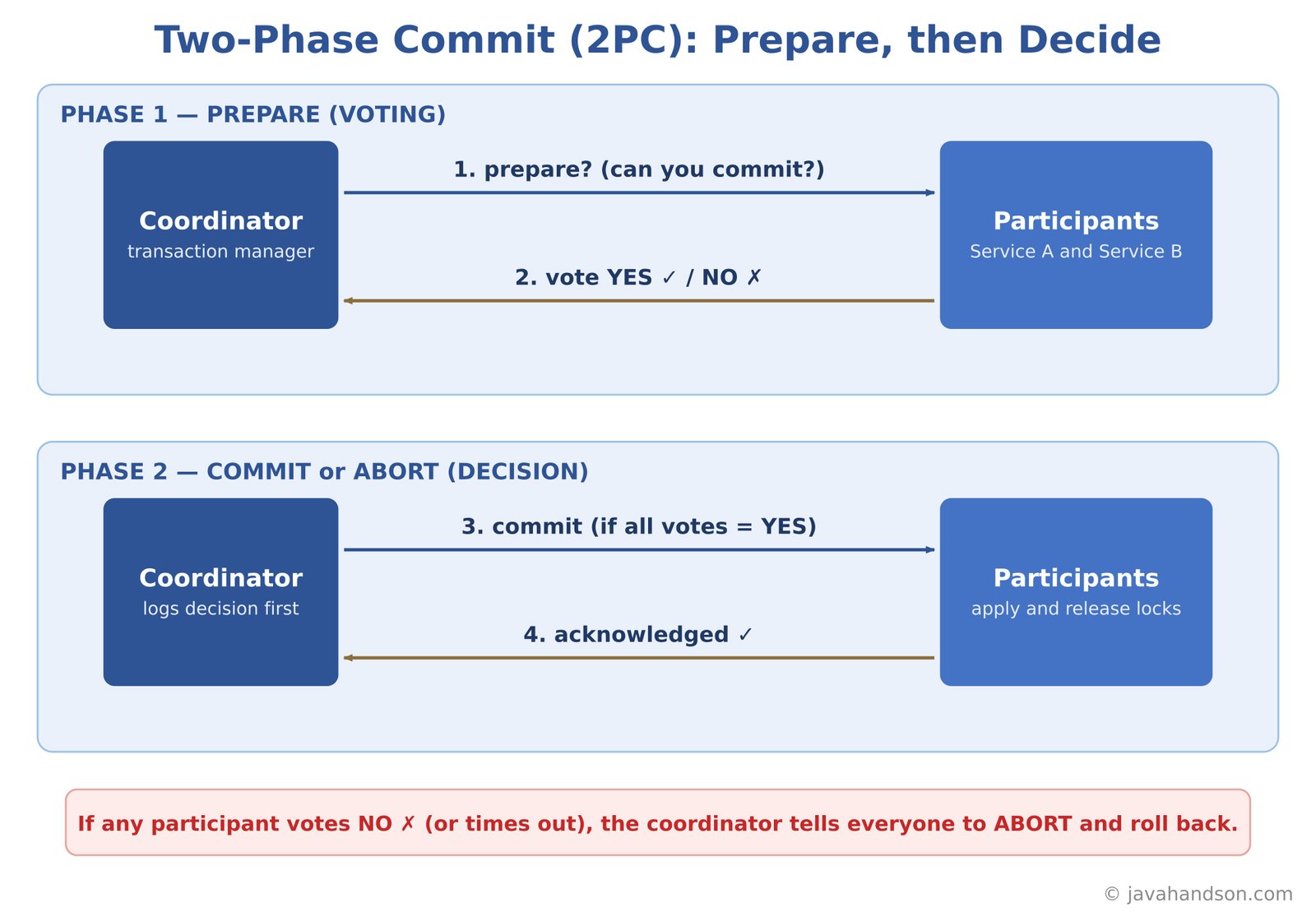
This is the voting phase. The coordinator sends a prepare message to every participant. In effect, it asks a simple question. “Are you able to commit this transaction?” It is not telling anyone to commit yet. It is only checking.
Each participant now does its local checks. It runs the work, holds any needed locks, and writes its changes to a durable log. But it stops just short of the final commit. Then it replies with a vote.
That last point matters a lot. Once a participant says yes, it has made a promise. It locks the data and sits in a waiting state. We call this the prepared or in-doubt state. The participant has given up its right to decide on its own.
This is the decision phase. The coordinator looks at all the votes it received. The rule is strict and simple. Every single vote must be yes.
If all votes are yes, the coordinator writes a commit record to its own log. This is the point of no return. After that, it sends a commit message to everyone. Each participant then makes its change permanent and releases its locks. Finally, each one sends back an acknowledgement.
But if even one vote is no, the plan changes. The coordinator decides to abort. It then tells every participant to roll back. Each one throws away its prepared work and releases its locks. The same thing happens if a participant does not reply in time.
| 💡 Interview Insight A common follow-up is: why does the coordinator write to its log before sending the commit message? Because that log entry is the single source of truth. If the coordinator crashes right after, it can recover and resend the decision. Without that log, the decision would be lost and participants would block forever. |
Theory is easier with a concrete story. So let us run a tiny example. Imagine placing an order on a shopping site. This action touches two services. The payment service must charge the card. Meanwhile, the inventory service must reserve the item. Both must succeed together.
The order service acts as the coordinator here. It starts the transaction and sends a prepare message to both services. Now each one gets ready.
That is the clean case. Both services moved as one unit. The customer paid, and the item is theirs. Nothing is half-done.
Now change one detail. Suppose the item just sold out. The inventory service cannot reserve it. So it votes NO in the prepare phase.
The coordinator now sees one no vote. By the rule, it must abort. It tells the payment service to roll back. The held funds are released, and no charge is made. The customer is not billed for an item they cannot get. So the system stays correct, even though the order failed.
You may have noticed how often logs show up above. That is not an accident. Durable logs are what make 2PC survive crashes at all. Without them, a single reboot would lose the state of the transaction.
Each actor logs at a key moment. A participant logs its prepared work right before it votes yes. The coordinator logs its final decision right before it sends it. These writes go to disk, so they survive a power loss.
So recovery becomes a matter of reading the log. When a crashed node comes back, it checks its records. A participant that finds a prepared entry knows it voted yes. It then asks the coordinator what to do. A coordinator that finds a commit entry knows the decision and simply resends it. In this way, the log turns a scary crash into a routine replay.
This section is the heart of the article. 2PC is correct on paper, but it lives in a world of crashes and lost messages. So we need to study what happens when things go wrong. Each failure point behaves differently, and some are far worse than others.
Suppose a participant crashes during the prepare phase, before it sends any vote. The coordinator waits for a reply, but none comes. After a timeout, the coordinator treats this silence as a no. So it aborts the whole transaction and tells the others to roll back.
This case is not too bad. The system stays safe. The transaction simply fails, which is the correct outcome when a participant is down. Availability takes a hit, but consistency holds.
This case is trickier. The participant voted yes and then went down. Remember, it saved its prepared work to the log before voting. So recovery is possible.
When the participant restarts, it reads its log and sees the prepared entry. Now it knows it is in doubt. It cannot decide on its own, because it promised to follow the coordinator. So it contacts the coordinator and asks for the final decision. Once it hears commit or abort, it finishes the job. The vote is honored, and atomicity survives.
Now the coordinator is the one that fails. Say it crashes after sending prepare messages but before it logs any decision. The participants have voted yes and are waiting. They hold their locks and sit in the in-doubt state.
Here is the painful part. The participants cannot move. They cannot commit, because maybe someone else voted no. Nor can they abort, because maybe everyone voted yes. There is no way for them to know. So they must wait for the coordinator to come back. This is the famous blocking problem, and we will return to it shortly.
This version is safer, thanks to the log. The coordinator wrote its decision to disk before it crashed. So the decision is not lost.
When the coordinator recovers, it reads its log. It finds the commit or abort record. Then it simply resends that decision to any participant still waiting. The participants apply it and move on. So a crash here causes delay, but not disaster. The outcome is already fixed; it just needs to be delivered.
A network partition splits the group into islands that cannot talk to each other. This is a nasty failure for 2PC. From one side’s view, the other side has simply vanished.
Imagine the coordinator ends up on one side and some participants on the other. Those cut-off participants may have voted yes already. Now they cannot reach the coordinator. So they are stuck in the in-doubt state, holding locks, waiting for a decision that cannot arrive. A partition, in effect, looks just like a coordinator crash to the stranded participants.
| 💡 Interview Insight When asked about 2PC failures, do not just list them. Rank them by severity. Participant failures and a post-decision coordinator crash are recoverable. The dangerous one is a coordinator crash after votes are collected but before the decision is logged. That is the scenario that strands participants with locks held, and it is the whole reason people avoid 2PC. |
The word “blocking” is the single most important label for 2PC. It describes the deepest weakness of the design. So let us unpack it carefully.
After a participant votes yes, it is locked into waiting. It holds locks on the rows it touched. It cannot release them until it hears the verdict. Normally the verdict comes fast, and all is well. But if the coordinator dies at the wrong moment, the verdict never arrives.
Now picture the fallout. Those locks stay held. Every new transaction that needs the same rows gets stuck behind them. The waiting spreads outward. One dead coordinator can freeze a slice of the system for as long as it stays down. Reports from the field describe outages lasting hours for exactly this reason.
The blocking problem points to a bigger design flaw. Our coordinator is a single point of failure. The whole protocol leans on this one actor. If it goes down at the wrong time, the group is helpless.
Teams try to soften this in a few ways. They can run the coordinator on reliable hardware. A replicated log lets a standby take over if the main node dies. Shorter timeouts help the system fail faster. Still, none of these fully removes the risk. The core design still centers on one decision-maker, and that remains its weak spot.
There is also a cost angle. Every commit needs two rounds of messages and several disk writes. So 2PC is slow compared to a local commit. As the number of participants grows, the latency and the chance of a failure both climb. That is why 2PC struggles at large scale.
People saw the blocking problem early and tried to fix it. The result was the three-phase commit protocol, or 3PC. The idea is to add one more phase so that participants are never left fully in the dark.
3PC splits the second phase of 2PC into two separate steps. First comes a pre-commit phase. The coordinator tells everyone “we are going to commit” before it tells them to actually commit. This extra signal spreads the decision around before the final act.
The pre-commit message is the clever bit. Once a participant gets it, it knows the group is heading toward commit. So if the coordinator later dies, a participant can reason about the outcome. If it saw the pre-commit, it can go ahead and commit after a timeout. If it did not, it can safely abort.
In theory, this removes the blocking problem. Participants can make progress without the coordinator in some cases. So 3PC is often called a non-blocking protocol.
Here is the twist. 3PC is almost never used in real systems. The reason is its assumptions. It only works well if the network is reliable and delays are bounded. Real networks are not like that.
A network partition can still fool 3PC into making two different decisions on two sides. So the guarantee breaks exactly when you need it most. On top of that, the extra phase adds more messages and more latency. So you pay a real cost for a guarantee that does not fully hold. That trade-off is why engineers skip it and look elsewhere.
Even with its flaws, 2PC is not just a textbook idea. It shows up in real products, mostly where strong consistency is worth the cost. So it helps to know where you might meet it.
A standard called XA defines how to run 2PC across different systems. It arrived back in 1991 and is still around. XA acts as the glue between a transaction manager and the data stores it coordinates. Many databases speak it.
Still, the trend in modern design is to avoid 2PC where possible. Microservices teams in particular tend to steer clear. The blocking risk and the scaling cost are simply too high for most high-traffic systems. So people reach for looser models instead.
There is one more real-world wrinkle worth a mention. Sometimes an in-doubt transaction blocks for too long. An operator may step in and force a decision by hand. This is called a heuristic decision.
It unblocks the locks, which is good. But it is risky. The operator is guessing the outcome. If the guess is wrong, two participants can end up disagreeing. So you trade a blocked system for a possible consistency break. It is a last resort, not a plan.
If 2PC is so risky, what do teams use instead? The honest answer is: it depends on how much consistency you truly need. Most modern systems accept weaker, looser guarantees in exchange for availability and speed.
The saga pattern is the most popular alternative. Instead of one big atomic transaction, a saga is a chain of smaller local transactions. Each service commits its own work right away. If a later step fails, the saga runs compensating actions to undo the earlier ones.
For our order example, the flow would change. Payment commits the charge. Inventory then tries to reserve stock. If that fails, a compensating step refunds the charge. There is no global lock and no single coordinator holding everyone hostage. So the system stays available, even during failures.
The trade-off is weaker consistency. For a brief window, the data can look odd. The charge exists before the refund lands. This is eventual consistency, and you must design for it. Still, for many systems, that is a fair price for staying up.
Another common tool is the transactional outbox. Here a service writes its data change and an outgoing event in one local transaction. A separate process then reads the outbox and publishes the event. So the local commit and the message stay in sync without any distributed lock.
| 💡 Interview Insight A strong interview answer frames 2PC as a stepping stone. Explain that it gives strong consistency but blocks and does not scale. Then pivot to sagas as the common microservices choice, and name the trade-off clearly: sagas give availability and eventual consistency instead of strict atomicity. Matching the pattern to the requirement is what interviewers reward. |
People trip on the same points when they first learn 2PC. Spotting these early saves you from shaky answers and buggy designs. Here are the ones that come up most.
System design interviews reward clear thinking over memorized facts. So structure your answer. Start with the problem of atomicity across services. Then introduce 2PC and its two phases. Next, walk through the failure modes and highlight the blocking problem.
After that, show judgment. Say plainly that 2PC gives strong consistency but at a high cost. Then offer the saga pattern as the usual modern choice. Finally, tie your pick to the requirement. If the task needs strict atomicity, 2PC may fit. If it needs high availability, a saga wins. That final link is what sets a strong answer apart.
Let us pull the main lessons together. These habits will serve you well when you design or discuss distributed systems.
| Term | Meaning in One Line |
|---|---|
| Distributed transaction | One logical action across many databases or services |
| Atomic commit | Either all participants commit, or all abort |
| Coordinator | The actor that drives the protocol and makes the final call |
| Participant | A service or database that votes and holds the data |
| Prepare phase | Phase 1: the coordinator asks everyone if they can commit |
| Commit phase | Phase 2: the coordinator tells everyone the final decision |
| In-doubt state | A participant voted yes and is waiting, holding locks |
| Blocking protocol | Participants can get stuck waiting for a dead coordinator |
| 3PC | A three-step variant meant to reduce blocking, rarely used |
| Saga pattern | Local commits with compensating actions instead of a global lock |
A: Two-phase commit is an atomic commit protocol that helps many services or databases agree to commit together or abort together. It runs in two steps: a prepare phase where a coordinator asks everyone if they can commit, and a decision phase where it tells everyone to commit or roll back.
A: Once a participant votes yes, it holds its locks and waits for the coordinator’s verdict. If the coordinator crashes after collecting votes but before sending the decision, that participant is stuck in an in-doubt state. It cannot commit or abort on its own, so it blocks and holds locks until the coordinator recovers.
A: A participant can fail before voting (safe abort), vote yes then crash (recovers from its log), or the coordinator can crash before the decision (dangerous blocking) or after it (safe resend). A network partition strands participants just like a coordinator crash. The worst case is a coordinator crash after votes but before the decision is logged.
A: Yes. The whole protocol depends on one coordinator to drive the decision. If it goes down at the wrong moment, participants are left waiting. Teams reduce the risk with reliable hardware, a replicated log, and shorter timeouts, but the core design still centers on one decision-maker.
A: 3PC adds a pre-commit phase so participants can make progress without the coordinator in some cases, which removes blocking in theory. In practice it is rarely used, because it only works under a reliable network with bounded delays. A network partition can still make two sides decide differently, and the extra phase adds latency.
A: Use 2PC when you truly need strict, strong atomicity across services and can accept the blocking risk and slower commits. Prefer the saga pattern for high-availability microservices that can tolerate eventual consistency. Sagas use local commits with compensating actions, so no global lock or single coordinator holds the system hostage.
Two-phase commit is a neat solution to a hard problem. It lets many independent services agree on a single outcome. The design is simple to follow: first ask everyone, then tell everyone. On paper, it delivers clean, strong consistency.
But the real world is less kind. The coordinator is a single point of failure. A crash at the wrong moment leaves participants blocked, holding locks, waiting for word that may never come. So 2PC is safe in theory and risky in practice. That gap is the key lesson of this article.
This is why most modern systems lean toward sagas and other looser models. They trade strict atomicity for availability, which fits high-traffic designs better. Learn 2PC well, understand its failure modes, and you will know exactly when to use it and when to walk away. That judgment is what good system design is all about.