Consensus in Distributed Systems: Leader Election and Raft Made Simple
-
Last Updated: November 9, 2026
-
By: javahandson
-
Series

Consensus in distributed systems made simple: learn leader election, terms, quorum, log replication, and Raft intuition with no Paxos proofs and no code.
Most backend systems start life on a single machine. One server holds the data, answers every request, and life is simple. Then traffic grows, and one machine is no longer safe. So you add more machines, and suddenly a hard question appears. If three or five servers all hold a copy of the same data, how do they agree on what is true? That single question is what consensus in distributed systems is all about.
This article tackles one of the most feared interview topics in plain language. We will skip the heavy mathematics. Instead, we will build a clear mental picture of how a group of servers picks a leader, keeps their data in sync, and keeps working even when some of them crash.
We will focus on Raft, a consensus algorithm that was designed for one reason above all: to be easy to understand. Along the way, we will touch on Paxos, but only lightly. The goal here is intuition, not proofs. By the end, you should be able to explain leader election and log replication to a colleague over coffee, and handle the topic calmly in a design interview.
Let us start with the “why” before the “how”. A distributed system runs on many machines, and any of them can fail at any moment. Networks drop messages. Disks die. A server freezes for a few seconds and then wakes up, confused about what it missed. Despite all this chaos, users expect one consistent answer.
Think about a simple bank balance. Suppose five servers each store your account. You withdraw money, and the request reaches three servers but not the other two. Now the system holds two different truths. Which one is correct? Without a rule for agreement, your balance becomes a matter of luck. Consensus is the rule that stops this mess.
Here is the mental model that engineers use. Imagine every server runs the same program, and that program only changes when it applies commands from a list. If every server applies the exact same commands in the exact same order, every server ends up in the exact same state. This idea is called a replicated state machine.
The shared list of commands is called a log. So the real job becomes smaller and clearer. You do not need the servers to agree on the final state directly. You only need them to agree on the order of entries in the log. Get the log right, and matching state follows for free.
Picture a small team writing in a shared notebook. If everyone scribbles at once, the notebook turns into noise. So the team picks one person to hold the pen. Others suggest what to write, but only the pen-holder actually writes, and everyone copies the same lines in the same order. That pen-holder is the leader, and the notebook is the log. This tiny idea sits at the heart of Raft.
Consensus means getting a group of servers to agree on a value, even when some servers fail or messages arrive late. That sounds abstract, so let us pin it down with the properties people actually care about.
Copying data is easy. Agreeing is the hard part. A leader can shout an update to four followers, but what if two of them never hear it? Later, a different server might try to lead and tell a conflicting story. A good consensus protocol makes sure that once a decision is final, nobody can quietly rewrite it.
Raft leans on one beautifully simple trick: the majority vote. A majority, also called a quorum, means more than half of the servers. In a cluster of five, a majority is three. Any decision needs the blessing of a majority before it counts as real.
Why does a majority work so well? Because two different majorities must always share at least one member. If one majority agreed to decision A and another tried to agree to decision B, the shared member would catch the clash and block it. That overlap quietly guarantees there is only one truth.
You will often see clusters of three, five, or seven servers. The odd number is deliberate. A cluster of 2f plus 1 servers can keep working while f of them are down. So five servers tolerate two failures, and three servers tolerate one. An even number wastes a machine, since four servers also tolerate only one failure, just like three.
| 💡 Interview Insight A classic interview question is “how many failures can your cluster survive?” The clean answer is simple. With N servers you need a majority to make progress, so you can lose fewer than half. For 2f plus 1 nodes, that means f failures. Say this, give the five-node example, and you sound confident without memorising anything. |
No consensus article is complete without naming Paxos. Paxos was the original, famous consensus algorithm, and for years it was the default answer in textbooks. It is proven correct and it works. However, it carries a reputation for being painfully hard to understand.
Many engineers read the Paxos paper, nod along, and still cannot explain how to build a working system from it. The core idea splits into pieces that feel disconnected, and real systems need extra machinery that the basic description leaves out. We will not walk through its proofs here, and honestly, you rarely need them on the job.
This gap is exactly why Raft was created. Diego Ongaro and John Ousterhout wrote a paper with a bold title: “In Search of an Understandable Consensus Algorithm.” Their main design goal was understandability itself. They wanted an algorithm that a normal engineer could read once, picture clearly, and implement correctly. That focus is why we spend the rest of this article on Raft.
Raft takes one scary problem and splits it into three smaller problems. This split is the real genius of the design, because each piece is easy to reason about on its own.
Everything in Raft flows in one direction, from the leader to the followers. There is no confusing back-and-forth where any server can change the shared log. This strong-leader style keeps the mental model clean. First we elect a boss, then the boss keeps everyone in sync, and a few safety rules protect us when the boss changes.
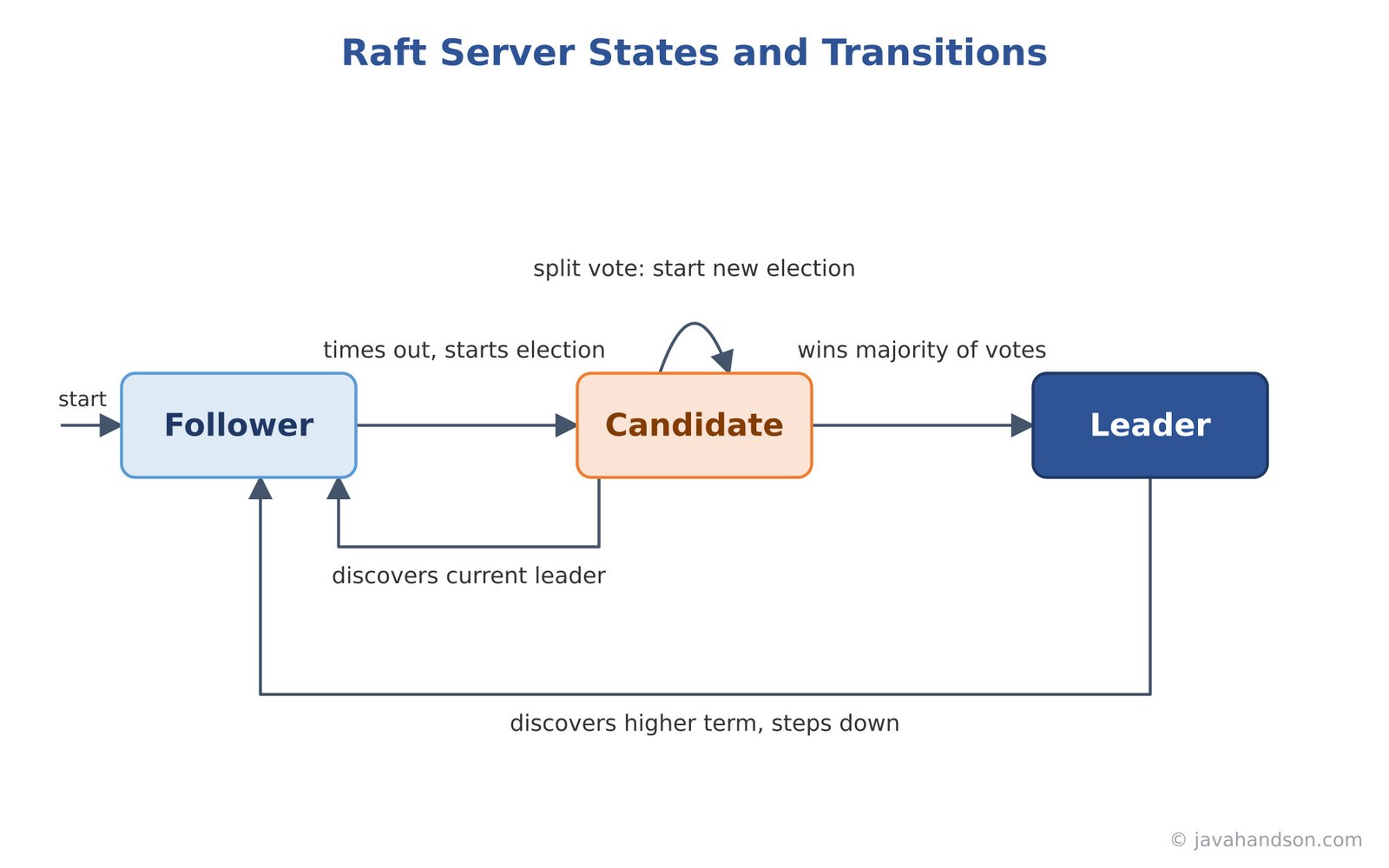
At any moment, every server in a Raft cluster sits in one of three roles. Understanding these three roles is half the battle, so let us go through each one slowly.
A follower is passive and calm. It does not start anything on its own. Instead, it waits for messages from the leader and replies to them. When a server first boots up, it begins as a follower. In normal times, almost every server is a follower, quietly copying whatever the leader sends.
A candidate is a server that wants the top job. If a follower stops hearing from the leader, it suspects the leader has died. So it promotes itself to candidate and asks the others to vote for it. This role is temporary, a short phase that exists only during an election.
The leader runs the show. It handles all client requests, writes new entries to its log, and pushes those entries out to the followers. A healthy cluster has exactly one leader at a time. To keep its position, the leader sends out steady signals so that followers know it is still alive and in charge.
Before we watch an election, we need one more idea: the term. Raft chops time into numbered periods called terms. Term 1, term 2, term 3, and so on. Each term begins with an election, and each term has at most one leader.
A term acts like a simple clock, but it counts events, not seconds. Every server remembers the current term number. Whenever servers talk to each other, they include this number in their messages. That small habit does a lot of useful work.
One detail surprises beginners. A term can end with no leader at all. If an election fails to produce a winner, that term simply has no leader, and the cluster moves on to the next term and tries again. Terms are cheap, so burning one on a failed election is not a problem.
Now for the part everyone asks about in interviews. Leader election is how a leaderless cluster, or one whose leader just crashed, picks a new boss. Let us walk through it as a short story.
Each follower runs a countdown timer called the election timeout. Every heartbeat from the leader resets this timer. As long as heartbeats keep arriving, the follower stays happy and does nothing. But if the timer runs out with no word from the leader, the follower assumes the worst and acts.
Follower election-timeout logic (pseudocode)
on each tick:
    if time_since_last_heartbeat > election_timeout:
        current_term = current_term + 1   // move to a new term
        state = CANDIDATE
        vote_for(self)                    // candidate votes for itself
send RequestVote to all other serversThe candidate increments the term, votes for itself, and sends a RequestVote message to every other server. Each server may vote only once per term, on a first-come, first-served basis. When a server receives a vote request, it says yes if it has not already voted for someone else in that term.
The candidate then simply counts replies. The moment it collects votes from a majority of the cluster, it wins. There is no arguing and no ranking of candidates. A plain majority is enough to settle the matter.
An election can end in exactly three ways, and a good candidate must handle all of them.
That third outcome has a name: the split vote. Suppose two followers time out at the same instant. Both become candidates, both ask for votes, and the cluster splits its support. Neither reaches a majority, so nobody wins, and the term is wasted.
Raft solves this with a clever, low-tech trick. Each server picks its election timeout randomly from a range, often between 150 and 300 milliseconds. Because the timers differ, one follower almost always wakes up first. It grabs votes before the others even start, and the split vote rarely happens twice in a row.
| 💡 Interview Insight Interviewers love to ask, “what stops two leaders from being elected forever?” Point to two safeguards. First, each server votes only once per term, so two leaders cannot both get a majority in the same term. Second, randomized timeouts break the tie quickly when a split does occur. Mention both, and you have covered safety and liveness in one breath. |
Once elected, a leader must defend its position. It does this with heartbeats. A heartbeat is just an AppendEntries message that carries no new log data. The leader sends these pings to every follower at a steady, rapid interval.
Each heartbeat resets the followers’ election timers. So as long as the leader stays alive and the network works, no follower ever times out, and no new election begins. The heartbeat interval is much shorter than the election timeout, which gives the leader plenty of room to prove it is alive before anyone panics.
Notice the neat design choice here. One message type, AppendEntries, does two jobs. It carries real log entries when there is work to do, and it serves as a heartbeat when there is nothing new. Fewer message types mean fewer bugs, which fits Raft’s whole spirit of simplicity.
Electing a leader is only half the story. The real purpose of the cluster is to agree on a growing list of commands. This is log replication, and the leader drives the whole process.
Here is what happens when things go well. A client sends a command to the leader, such as “set x to 5”. The leader does not apply it right away. Instead, it follows a careful sequence that protects the data.
Each log entry holds three small things: an index, the term in which it was created, and the actual command. The index gives the entry its position in the list. The term stamps it with a time period. Together, these let any two servers compare logs and spot differences instantly.
The word committed is the key to the whole design. An entry is committed once the leader has safely stored it on a majority of servers. That majority is the point of no return. After it, the entry is permanent, and even a leader crash cannot erase it.
Commit rule (pseudocode)
entry is committed when:
    the entry is stored on a MAJORITY of servers
    AND it was created in the leader's current term

only committed entries are applied to the state machine
This is why a client only gets a success reply after a commit. The system never confirms a write it might later lose. If the leader dies one millisecond after committing, the data still lives on a majority, and the next leader will have it. That promise is what makes the system trustworthy.
Networks are messy, so followers often miss some entries. Maybe a follower was slow, or restarted, or briefly lost its connection. The leader handles this quietly. It tracks how far each follower has progressed and keeps retrying older entries until that follower catches up.
If a follower’s log ever conflicts with the leader’s, the leader wins. The follower throws away its mismatched entries and copies the leader’s version instead. This sounds harsh, but it keeps the rule dead simple. There is one source of truth, the leader’s log, and everyone eventually matches it.
We now reach the subtle part, but do not worry, the intuition is friendly. Imagine a leader commits an entry and then crashes. What if a server that never received that entry becomes the next leader? It would lead with a hole in its history, and the committed entry would vanish. Raft must stop this, and it does, with one clever voting rule.
When a candidate asks for a vote, it includes details about its own log. Each voter then checks a simple condition before saying yes. A server grants its vote only if the candidate’s log is at least as up to date as its own.
“Up to date” has a precise meaning here, and it is easy to remember. The voter compares the term of the last log entry first. A higher term wins. If the terms match, the longer log, meaning the one with the higher index, wins. A candidate that is behind simply cannot collect a majority.
Now connect the two ideas. A committed entry lives on a majority of servers. To win an election, a candidate also needs a majority of votes. Those two majorities must overlap in at least one server, and that server holds the committed entry. It will refuse to vote for anyone missing that entry.
So the winner always has every committed entry already. This guarantee has a name, leader completeness, and it is the quiet hero of Raft. Because of it, a committed entry can never be lost, no matter how many leaders come and go. You do not need the formal proof to trust the picture.
| 💡 Interview Insight If an interviewer pushes on safety, do not panic or recite proofs. Just tell the overlap story. Committed means stored on a majority. Winning means votes from a majority. Two majorities always share a server, and that shared server will not vote for a candidate missing a committed entry. That single sentence shows you truly understand Raft. |
Let us tie everything together with one concrete story. Say we have five servers, named S1 through S5, running happily in term 4. S1 is the leader, and the other four are followers.
First, the normal flow. A client asks to store a value. S1 appends it to its log and sends it to the four followers. Three of them reply quickly, so S1 now has itself plus three copies, a majority of five. S1 commits the entry, applies it, and tells the client “done”. So far, so good.
Now disaster strikes. S1 crashes and goes silent. The four followers wait for heartbeats, but none arrive. Their election timers tick down, and thanks to randomization, S3 times out first. It jumps to term 5, votes for itself, and asks the others for support.
Here is where safety shines. S3 had copied that last committed entry, so its log is current. The other followers check S3’s log, find it up to date, and happily vote yes. S3 collects a majority, becomes the new leader for term 5, and starts sending heartbeats. The cluster recovers in a fraction of a second.
Finally, S1 wakes up and still thinks it is the leader of term 4. It tries to send an old heartbeat. But every server now lives in term 5, so they reject the stale message and tell S1 the new term. S1 realises it is outdated, steps down to follower, and syncs up. No data was lost, and no two leaders ever ran at once.
Raft is not just a classroom idea. It quietly powers a lot of the infrastructure that modern systems depend on. Knowing a few real examples makes the concept stick, and it also impresses interviewers who like practical grounding.
Notice the common thread. Each of these systems must hold some critical state that cannot afford to disagree, such as configuration, cluster membership, or metadata. Raft gives them a dependable, well-understood way to keep that state safe across failures. When you need a group of servers to agree without drama, Raft is usually the tool people reach for.
Beginners tend to trip over the same few points. Spotting them early will save you both bugs and interview stumbles.
System design interviews reward clear stories over memorised definitions. When consensus comes up, start with the problem. Explain that many servers must agree despite failures, and that Raft solves this by electing a leader and replicating a log.
Next, structure your answer around Raft’s three pieces: leader election, log replication, and safety. This framing alone signals real understanding. If asked to go deeper, describe the election timeout, the majority vote, and the role of heartbeats, in that order.
Finally, be ready for the “why not Paxos” question. Keep it gracious and short. Say that Paxos is correct but famously hard to understand, while Raft was designed for clarity, which makes it easier to build and operate. That answer shows maturity without starting a holy war.
Let us turn all this theory into a few habits you can carry into real design work.
| Term | Meaning in One Line |
|---|---|
| Consensus | Getting many servers to agree on one value despite failures |
| Replicated state machine | Same commands, same order, so every server reaches the same state |
| Log | The ordered list of commands that servers must agree on |
| Leader | The one server that accepts writes and drives replication |
| Follower | A passive server that copies the leader’s log |
| Candidate | A server running for leader during an election |
| Term | A numbered time period that acts as Raft’s logical clock |
| Quorum (majority) | More than half the servers; needed for any safe decision |
| Committed entry | A log entry safely stored on a majority, now permanent |
| Heartbeat | An empty AppendEntries message that keeps the leader in charge |
A: Consensus is the problem of getting a group of servers to agree on a single value or on the order of commands, even when some servers crash or messages get delayed. It is what lets many copies of your data stay in sync and show one consistent answer.
A: Leader election is how a Raft cluster picks one server to be in charge. When a follower stops hearing heartbeats, it becomes a candidate, votes for itself, and asks others for votes. If it gets a majority, it becomes the leader for that term and starts sending heartbeats.
A: Raft was designed with understandability as its main goal. It splits consensus into three clear parts — leader election, log replication, and safety — and keeps data flowing in one direction from the leader to followers. Paxos is correct but famously hard to picture and build from its basic description.
A: Raft needs a majority to make any decision, so a cluster of 2f plus 1 servers can survive f failures. Five servers tolerate two failures, and three tolerate one. An even number wastes a machine, since four servers also tolerate only one failure, just like three.
A: An entry is committed once the leader has safely stored it on a majority of servers. After that point it is permanent and survives leader crashes. The client only receives a success reply after the commit, so the system never confirms a write it might later lose.
A: Two safeguards. Each server votes only once per term, so two candidates cannot both reach a majority in the same term. And randomized election timeouts (often 150–300 ms) make one follower wake up first, which prevents and quickly resolves split votes.
Consensus feels intimidating from the outside, but the core idea is calm and simple. A group of servers must agree even when some of them fail. Raft reaches that goal by electing one leader, replicating a shared log, and guarding a few safety rules. Break the problem into those three pieces, and the fog clears.
Keep the key pictures in mind. Terms act as a clock, a majority makes every decision real, randomized timeouts settle elections, and the up-to-date log rule protects committed data. None of this needs heavy mathematics. It needs a clear model and a bit of practice.
Carry this intuition into your next design discussion. When someone asks how your system stays consistent across machines, you can now answer with a story instead of a shrug. Master these basics, and the deeper distributed systems topics ahead will feel far less scary.