takeWhile and dropWhile in Java 9: Stream API Improvements
-
Last Updated: November 4, 2026
-
By: javahandson
-
Series

Learn takeWhile and dropWhile in Java 9 with simple, runnable examples — plus Stream.ofNullable and the new finite iterate. A beginner-friendly guide.
Java 8 gave us streams, and most of us fell in love with them fast. Still, streams in Java 8 had a few rough edges. You could filter data all day. Yet you could not tell a stream to stop early once a condition broke. Java 9 quietly fixed many of these small pains. The new takeWhile and dropWhile in Java let a stream stop or skip based on a simple rule. Two more helpers join them: Stream.ofNullable and a smarter Stream.iterate. This guide walks through all four, in very plain language.
My goal here is to keep things beginner friendly. Each method gets a tiny example you can paste and run. Along the way, I will point out the mistakes I keep seeing in real code and in reviews. By the end, you will know exactly when to reach for each one, and why.
These four additions look small on paper. In daily work, though, they remove a surprising amount of boilerplate. So let us start with a quick map of what changed.
Java 9 did not rewrite streams. Instead, it added four handy methods on top of the Java 8 base. Here is the short version:
Notice the pattern. Two methods slice a stream by a condition. One method handles a possibly-null value cleanly. The last one gives you a stream that knows when to quit. None of them are hard. All of them save typing.
A small detail helps here. takeWhile and dropWhile are intermediate operations. They return a new stream, so you can chain more steps after them. ofNullable and iterate, on the other hand, are static factory methods. They sit at the very start of a pipeline and create the stream itself.
You might wonder if these are just nice-to-have tricks. In my experience, they earn their place quickly. Real data is often sorted or grouped. And you frequently care about only the front portion of it.
Think about a sorted list of prices, log lines with a header, or sensor readings that warm up before they settle. In each case, you want the leading part, or you want to skip it. Before Java 9, you solved this with an index, a flag, or a clumsy filter. Now one method says it directly.
ofNullable and the finite iterate follow the same spirit. Both replace small, repetitive guard code with a single clear call. Less boilerplate means fewer bugs. It also means code that reads closer to plain English.
You only need a JDK of version 9 or newer. Any modern build works too, so Java 17, 21, or 25 are all fine. The methods have not changed since Java 9, so the behaviour stays the same across versions. An IDE like IntelliJ helps, but a plain text editor and the command line also do the job.
There are no libraries to add. All four methods sit in the standard java.util.stream package, which every JDK ships. Every snippet below is complete enough to drop into a main method. I use Collectors.toList() in a few places so the code runs on Java 9 as-is. Feel free to swap in the newer toList() shortcut on Java 16 and above.
takeWhile reads from the front of the stream. It keeps each element as long as your predicate returns true. The moment the predicate returns false, it stops. takeWhile ignores everything after that point, even if some later elements would have passed.
Think of a queue at a gate. The guard lets people through while they hold a valid pass. The first person without a pass stops the line for good. takeWhile works the same way. That first false ends the flow completely.
Imagine a list of numbers. We want the leading run of even numbers, nothing more. Here is how takeWhile handles it:
import java.util.List;
import java.util.stream.Collectors;

public class TakeWhileDemo {
    public static void main(String[] args) {
        List<Integer> numbers = List.of(2, 4, 6, 7, 8, 10, 12);

        List<Integer> taken = numbers.stream()
                .takeWhile(n -> n % 2 == 0)   // keep while the number is even
                .collect(Collectors.toList());

        System.out.println(taken);   // [2, 4, 6]
    }
}
The output is [2, 4, 6]. The stream met 2, 4, and 6, which are all even. Then it hit 7, which is odd, so the predicate failed. At that spot takeWhile stopped. The 8, 10, and 12 never entered the result, even though they are even.
This trips up a lot of beginners. filter checks every single element. takeWhile only checks the leading run. So compare the two on the same data:
List<Integer> numbers = List.of(2, 4, 6, 7, 8, 10, 12);

// filter keeps EVERY even number, wherever it sits
numbers.stream().filter(n -> n % 2 == 0).forEach(System.out::print);
System.out.println();   // prints: 24681012

// takeWhile stops at the first odd number
numbers.stream().takeWhile(n -> n % 2 == 0).forEach(System.out::print);
System.out.println();   // prints: 246
See the gap? filter gives you 2 4 6 8 10 12, because it scans the whole stream. takeWhile gives you only 2 4 6, because it quits at the first failure. So filter asks “which elements match?”. Meanwhile takeWhile asks “how long does the match hold from the start?”
| INTERVIEW INSIGHT takeWhile short-circuits. It stops the instant the predicate turns false. On a very large or even infinite stream, it will not scan everything. That short-circuit behaviour is the key difference from filter, and interviewers love to probe it. |
Short-circuiting is not just a party trick. On sorted data it saves real work. Suppose you hold a sorted list of response times. You want only the fast ones, those at or under 100 milliseconds:
import java.util.List;
import java.util.stream.Collectors;

public class TakeWhileSorted {
    public static void main(String[] args) {
        // response times in ms, already sorted ascending
        List<Integer> sorted = List.of(40, 55, 80, 120, 200, 350);

        List<Integer> fast = sorted.stream()
                .takeWhile(ms -> ms <= 100)   // only the fast ones at the front
                .collect(Collectors.toList());

        System.out.println(fast);   // [40, 55, 80]
    }
}
The result is [40, 55, 80]. Because the list is sorted, takeWhile can trust the order. It stops at 120 and never looks at 200 or 350. On a large sorted dataset, that early exit is a real speed win.
dropWhile is the mirror image of takeWhile. It throws away the leading run that matches your predicate. Once the predicate fails for the first time, dropWhile stops dropping. From there, it keeps every remaining element, no questions asked.
Picture skipping the opening credits of a film. You fast-forward while the credits roll. Once the real scene starts, you stop skipping and watch the rest. dropWhile does exactly that with stream elements.
Take the same list of numbers. This time we want to skip the leading even numbers and keep whatever follows:
import java.util.List;
import java.util.stream.Collectors;

public class DropWhileDemo {
    public static void main(String[] args) {
        List<Integer> numbers = List.of(2, 4, 6, 7, 8, 10, 12);

        List<Integer> rest = numbers.stream()
                .dropWhile(n -> n % 2 == 0)   // drop while even, then keep the rest
                .collect(Collectors.toList());

        System.out.println(rest);   // [7, 8, 10, 12]
    }
}
The result is [7, 8, 10, 12]. The first three values, 2, 4, and 6, were even, so dropWhile dropped them. Then it reached 7, which broke the rule. From that spot onward, every element stayed, including the even 8, 10, and 12.
Here is the part people forget. dropWhile touches the leading run alone. After the first false, it never tests anything again. So matching elements that appear later are completely safe. A config file makes this clear:
import java.util.List;

public class HeaderSkipDemo {
    public static void main(String[] args) {
        List<String> lines = List.of(
                "# config file",
                "# do not edit",
                "host=localhost",
                "port=8080",
                "# trailing note"
        );

        lines.stream()
             .dropWhile(line -> line.startsWith("#"))   // skip the comment header
             .forEach(System.out::println);
    }
}
The output keeps three lines: host=localhost, port=8080, and # trailing note. The two header comments at the top were dropped. But the last line still starts with a hash, yet it survives. Why does it stay? Because dropWhile had already stopped dropping at host=localhost. It does not go hunting for more comments later.
| INTERVIEW INSIGHT dropWhile does NOT short-circuit. It must walk from the start to find where the dropping ends. After that boundary, it keeps the rest without testing them. So takeWhile can stop early on huge streams, but dropWhile still has to reach the boundary first. |
dropWhile shines when you trim a messy start. Sensors often send junk while they warm up. Say the first few readings are zeros you want to ignore:
import java.util.List;
import java.util.stream.Collectors;

public class DropWhileWarmup {
    public static void main(String[] args) {
        // the sensor warms up: leading zeros are junk
        List<Integer> readings = List.of(0, 0, 0, 7, 9, 0, 12);

        List<Integer> real = readings.stream()
                .dropWhile(r -> r == 0)   // drop the leading zeros only
                .collect(Collectors.toList());

        System.out.println(real);   // [7, 9, 0, 12]
    }
}
The output is [7, 9, 0, 12]. The three leading zeros vanish. Yet the zero in the middle stays, because dropWhile stopped the moment it saw 7. This is the same front-only rule from before, now in a practical shape.
Both takeWhile and dropWhile depend on order. They work on the “front” of the stream, so the stream needs a meaningful front. A List has a clear order. Streams from Stream.of(…) keep their order as well. So does a sorted stream. For all of these, the results are predictable, every single run.
Now comes the catch. Some sources have no reliable order. A HashSet is the classic example. When you stream an unordered source, the “first” element is not fixed. So takeWhile and dropWhile turn non-deterministic. They may keep or drop a different subset each time.
import java.util.Set;

public class UnorderedTrap {
    public static void main(String[] args) {
        // Set.of(...) is unordered: the result here is NOT guaranteed
        Set.of(2, 4, 6, 7, 8).stream()
           .takeWhile(n -> n % 2 == 0)
           .forEach(System.out::println);
        // output can vary between runs or JVMs
    }
}
The reason is simple. These two methods answer a question about position. What comes first, and how long does the run last? A set makes no promise about position. So the question has no stable answer, and the JVM may pick any matching subset.
The official docs say it plainly. On an unordered stream, the operation may drop or take any matching subset, including the empty set. In short, do not use these methods on a HashSet and expect a stable answer.
Making an unordered source safe is easy. Call sorted() first, and the stream gains a defined order. After that, takeWhile and dropWhile behave predictably again. Of course, sorting costs a little time. So reach for it only when you truly need ordered slicing.
Before Java 9, a null value and streams did not mix well. Stream.of(null) throws a NullPointerException. So you had to add null checks before building a stream. That extra code added noise to simple pipelines.
This came up a lot with map lookups. A missing key returns null. Wrapping that null in Stream.of blew up with an exception. So pipelines filled up with tiny null guards that hid the real logic.
Stream.ofNullable fixes this. Give it a value, and it returns a stream of one element. Give it null, and it returns an empty stream. No exception, no fuss:
import java.util.stream.Stream;

public class OfNullableDemo {
    public static void main(String[] args) {
        Stream.ofNullable("hello").forEach(System.out::println); // prints: hello
        Stream.ofNullable(null).forEach(System.out::println);    // prints nothing
    }
}
The first call prints hello, because the value is present. The second prints nothing at all, since the null simply became an empty stream. That is the whole idea, and it stays wonderfully boring in the best way.
Why does this help so much? It removes a whole class of tiny bugs. You no longer guess whether a value exists before streaming it. Instead, ofNullable makes the empty case the normal case, and your pipeline just flows on.
One element or zero elements may sound useless on its own. The magic appears inside flatMap. Say you look up several keys in a map, and some keys are missing. ofNullable lets you skip the missing ones without a single if-check:
import java.util.HashMap;
import java.util.List;
import java.util.Map;
import java.util.stream.Collectors;
import java.util.stream.Stream;

public class OfNullableFlatMap {
    public static void main(String[] args) {
        Map<String, String> config = new HashMap<>();
        config.put("host", "localhost");
        config.put("port", "8080");

        List<String> keys = List.of("host", "port", "user");

        List<String> values = keys.stream()
                .flatMap(key -> Stream.ofNullable(config.get(key)))
                .collect(Collectors.toList());

        System.out.println(values);   // [localhost, 8080]
    }
}
The key “user” is not in the map, so config.get returns null. ofNullable turns that null into an empty stream. flatMap then flattens it away to nothing. The result is a clean [localhost, 8080], with no null checks and no NullPointerException. Before Java 9, you would have written a filter or an if just to guard this.
One quick note to avoid confusion. Stream.ofNullable lives on the Stream class, and it builds a stream. It is a cousin of the null-friendly Optional methods, but it is not the same tool. Reach for ofNullable when you are already inside a pipeline and a value might be null.
Java 8 already had Stream.iterate, but it took only two arguments: a seed and a next function. That version never stops on its own. It produces an endless stream. So you always had to bolt on a limit() to keep it finite.
import java.util.stream.Stream;

// Java 8 style: infinite, so limit() is mandatory
Stream.iterate(1, n -> n + 1)   // 1, 2, 3, 4, ... forever
      .limit(5)
      .forEach(System.out::println);   // 1 2 3 4 5
The two-argument form is still useful. It fits truly endless sequences that you cap later with limit or takeWhile. But when you know the end up front, carrying a separate limit felt clumsy.
Java 9 added a three-argument overload. The middle argument is a predicate named hasNext. The stream keeps going only while that predicate stays true. It reads almost like a for-loop, and you need no limit():
import java.util.stream.Stream;

// Java 9 style: stops itself, no limit() required
Stream.iterate(1, n -> n <= 5, n -> n + 1)
      .forEach(System.out::println);   // 1 2 3 4 5
The three parts map neatly onto a for-loop. Here, the seed 1 is the start. Next comes the predicate n <= 5, which is the loop condition. The function n -> n + 1 is the step. Put together, you get 1, 2, 3, 4, 5, and then it halts.
This overload shines when the step is not a simple plus-one. Doubling is a nice example. Here we generate powers of two up to 100:
import java.util.stream.Stream;

Stream.iterate(1, n -> n <= 100, n -> n * 2)
      .forEach(System.out::println);
// 1, 2, 4, 8, 16, 32, 64
The sequence stops at 64. The next value would be 128, which fails the n <= 100 test, so the stream ends there. Writing this as a classic for-loop works too. The stream version, though, plugs straight into map, filter, and the rest of the pipeline.
| INTERVIEW INSIGHT the seed is included in the output. Stream.iterate(1, n -> n <= 5, n -> n + 1) prints 1, 2, 3, 4, 5, not 2 to 5. The hasNext test runs before each element, and the seed is the very first candidate it checks. |
These methods are nice alone. They are even nicer when chained. Suppose you want the leading run of numbers below 10, drawn from a finite 1-to-20 sequence. The finite iterate builds the data, and takeWhile trims it:
import java.util.stream.Stream;

public class CombinedDemo {
    public static void main(String[] args) {
        Stream.iterate(1, n -> n <= 20, n -> n + 1)   // finite: 1..20
              .takeWhile(n -> n < 10)                 // stop at the first 10+
              .forEach(System.out::print);            // 123456789
    }
}
The iterate call produces 1 through 20 and stops cleanly. Then takeWhile keeps 1 through 9 and quits at 10. Together they read like a sentence. No manual counter, no limit(), and no stray state to manage.
You can push this further. Swap takeWhile for dropWhile to skip a warm-up, or add a map in the middle to transform values. The real point is that these methods compose. Each one is a small, honest building block inside a larger pipeline.
Streams are lazy by design. Nothing actually runs until a terminal step like forEach or collect pulls the data. takeWhile uses this laziness fully. It fetches elements one at a time and stops the instant the predicate fails.
This pays off on big or endless streams. Pair the two-argument iterate with takeWhile, and an infinite source becomes safe and bounded:
import java.util.stream.Stream;

// Safe on an infinite stream: takeWhile ends it
Stream.iterate(1, n -> n * 2)       // infinite: 1, 2, 4, 8, ...
      .takeWhile(n -> n < 1000)     // short-circuits, so it stops
      .forEach(System.out::print);  // 1 2 4 8 16 32 64 128 256 512
Here the stream doubles forever, in theory. takeWhile cuts it off at the first value of 1000 or more. So the program prints a tidy 1 2 4 8 16 32 64 128 256 512, and then it exits.
dropWhile behaves differently, and this catches people out. It does not short-circuit. Handing it an infinite stream means it searches forever for the end of the run. In short, takeWhile can tame an infinite stream, but dropWhile cannot.
There is a simple rule of thumb. If a stream might be infinite, only takeWhile or limit can make it finite. dropWhile and filter will not. So place your bounding step with care whenever the source has no natural end.
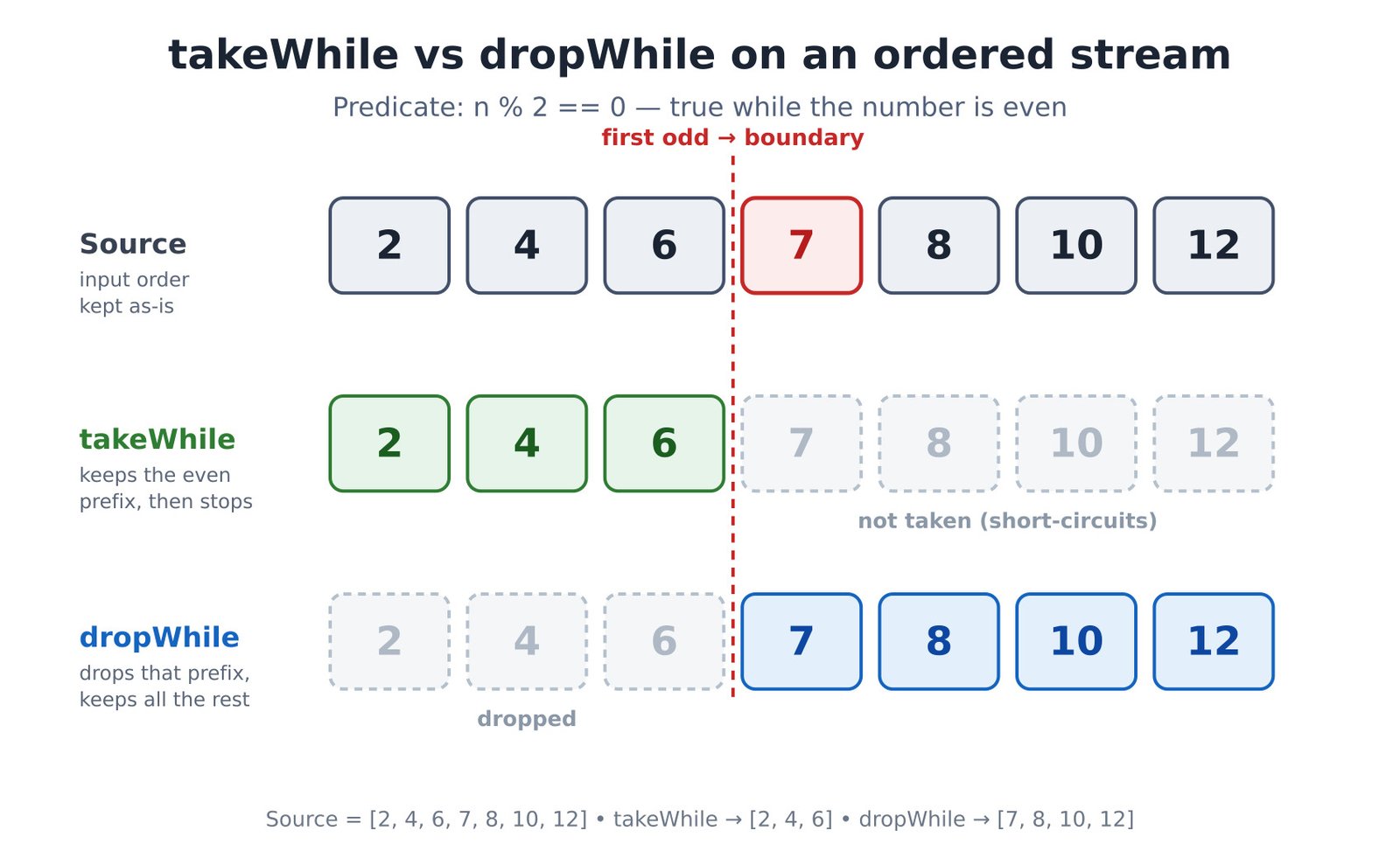
If you remember one thing, remember this. takeWhile and dropWhile split an ordered stream at the same boundary. That boundary is the first element where the predicate turns false.
takeWhile gives you everything before that boundary. dropWhile gives you the boundary element and everything after. Run both with the same predicate on the same ordered stream, and you rebuild the original list. One keeps the head, while the other keeps the tail.
ofNullable and the finite iterate sit slightly apart, yet share a theme. Each turns an awkward edge case into a normal stream. A null becomes an empty stream. An endless loop becomes a bounded one. That shared theme is what Java 9 streams are really about: fewer special cases, and more plain pipelines.
No, and this point is worth stressing. Streams never touch the source. takeWhile, dropWhile, ofNullable, and iterate all produce new streams or new values. Your original List or Set stays exactly as it was. So you can run several different slices on the same list, with no surprise side effects.
This fits the wider stream philosophy. You describe what you want, not how to loop. The stream builds a fresh result and leaves your data alone. As a bonus, that makes the code easier to reason about, and far easier to test.
Most bugs with these methods come from a handful of wrong assumptions. So watch out for these:
None of these are hard to fix once you know them. The common thread is order and short-circuiting. Keep both in mind, and these methods behave exactly as you expect.
Here is the short decision guide I keep in my head:
Keep one more thing in mind. takeWhile and dropWhile care about order, so feed them ordered streams. That single habit prevents most of the surprises.
A: filter checks every element and keeps all that match. takeWhile only checks the leading run and stops at the first element that fails the predicate. So filter scans the whole stream, while takeWhile short-circuits and ignores everything after the first false.
A: No. dropWhile must walk from the start to find where the dropping ends. After that boundary it keeps every remaining element without testing them. Because it does not short-circuit, dropWhile cannot make an infinite stream finite, whereas takeWhile can.
A: Stream.ofNullable returns a stream of one element when the value is non-null, and an empty stream when it is null. It avoids the NullPointerException that Stream.of(null) throws, which makes it handy inside flatMap for skipping missing values.
A: The Java 8 two-argument iterate(seed, next) is infinite and needs a limit(). The Java 9 iterate(seed, hasNext, next) adds a predicate that stops the stream on its own, much like a for-loop. The seed is included as the first value tested.
A: Both methods act on the front of the stream, so they need a defined order. A HashSet or Set.of() has no reliable order, so the result becomes non-deterministic and can change between runs. Call sorted() first, or start from an ordered source like a List.
takeWhile and dropWhile in Java 9 give streams something they lacked in Java 8: a way to stop or skip based on a condition. takeWhile keeps the leading run that matches and short-circuits at the first false. dropWhile throws that run away and keeps everything after it. Both split an ordered stream at the same boundary, so feed them ordered sources.
Stream.ofNullable and the three-argument Stream.iterate round out the update. One turns a possible null into an empty stream, and the other gives you a sequence that stops on its own, much like a for-loop. None of the four methods changes your source data, and all of them behave the same on Java 11, 17, 21 and later. Run each snippet once, keep the order rule in mind, and you will reach for the right method without a second thought.